

Introduction
Corruption refers to dishonest or fraudulent behavior by individuals in positions of power or influence. It includes acts such as dishonesty, fraud, bribery, and misconduct. In essence, a person is corrupt when he/she uses their position or influence for personal gain. Corruption represents dishonesty and can be considered a form of theft. This article discusses the topic ‘what is corruption, and types of corruption.’
What is corruption
Mahatma Gandhi said, “The world has enough for everyone’s need, but not enough for everyone’s greed.” Greed often drives people to corrupt acts and practices to earn illegal wealth. Lack of personal integrity and greed are key drivers of corruption.
Corruption is the misuse or abuse of a public office or a position of influence for pecuniary gain. The act of corruption may not always result in a direct financial gain. However, in a majority of corrupt cases, money is the bribe.
Corruption can take many forms, including nepotism, long-range patronage, and some of these forms may not be immediately visible to the eye of the public or law-enforcing forces.
Corruption erodes the trust of the people in the government and affects good governance. Corruption can affect the livelihood, education, healthy environment, job, and even the life of the common man.

Main features of corruption
Main features of corruption are:
- Corruption can happen anywhere, viz. educational institutions, government, places of worship, business, courts, law enforcement departments, and in places beyond your imagination.
- Corruption thrives and flourishes when the system is non-transparent or opaque. Such a system is a heaven for corrupt people.
- Corruption cannot be eliminated as long as there are people who want to get their work done faster or illegally. It takes two hands to clap. Unless people stop giving bribes, corruption cannot be rooted out.
- As the government builds transparency into the system, corrupt people can find ingenious ways to keep their business going. So, the government should be watchful and ahead in technology.
- Corruption can snatch away your healthy environment. You are watching this every day. Lakes are polluted by factories, indiscriminate urbanization takes away the surrounding greenery, and so on. Many of these things will not happen if the government and its employees work with only one goal: ‘welfare of the people.’
- Corruption can swallow the government welfare funds, including those meant for educational and medical facilities for citizens. The result is low-quality education and medical facilities.
- We can only keep corruption in check if the citizens, businesses, organizations, and the government work together.
- Corruption and crime may have a relation in some cases. A crime may be committed to cover up corruption or to silence the voices against corruption.
Types or categories of corruption
Corruptions can have many avatars, including Government officers demanding bribes from the public, politicians misusing public money, nepotism and favoritism, companies bribing officials and politicians in exchange for lucrative deals and contracts, and so on.
Corruption can be broadly categorized as follows. These are only major categories.
- Petty corruption
- Grand or large corruption
- Political corruption
- Administrative corruption
- Fraud
- Embezzlement
- Nepotism and favoritism
- Kickbacks
Petty corruption
Petty corruption involves a small amount of money and is encountered by a common person during their legal interactions with government officials. The government official may demand and receive a bribe for doing the services for which he/she is appointed.
Petty corruption may happen in the offices of vehicle permits, driving licenses, registration, police stations, etc. The bribe amount may go up and can be sufficiently high if the person requests a service for which he or she was not entitled. In many cases, petty corruption happens through middlemen or agents.

Grand or large-scale corruption
Large-scale corruption does not happen regularly and will come to the notice of the public only when it is exposed by law-enforcing agencies and auditors. Grand corruption involves influential and rich peoples, and the formulation of policies at the government level. The government may formulate policies favorable to particular individuals or companies. A huge amount of money can be exchanged hands in large-scale corruption.
Grand corruption happens at the highest levels of the government and may involve senior officers and ministers.
Grand corruption can happen when the government lacks transparency and proper systems. Giving discretionary power to the officials and ministers can lead to corruption.
Political corruption
This involves politicians of all categories. A corrupt politician in a powerful position can abuse his/her public office to favor certain individuals or companies in return for a financial gain. Often, this corruption manifests as favoritism and nepotism toward relatives and friends. It is the illegitimate use of public office for personal gain.
Administrative corruption
The civil service and bureaucrats implement the welfare policies of the central and state governments. The policies can be public welfare schemes, public food distribution, education, medical services, and so on. Civil servants can distribute the benefits to non-eligible persons and take bribes. Such corrupt actions deprive the eligible persons of their benefits.
Due to administrative corruption, the benefits of the government’s welfare policies do not reach all the eligible people.
Fraud
Fraud involves cheating the government by individuals or companies. The cheating can be paying reduced or nil-income tax by hiding actual income, paying low taxes by manipulating the books of accounts of companies and businesses, evading taxes by corrupt practices, and others. Such frauds often take place with the active support of a civil servant from the respective department.
Companies take huge loans from banks and intentionally fail to repay them by declaring losses. The company may have smartly diverted the money to its other businesses. Such stories are familiar to regular readers of the newspaper.
Embezzlement
Embezzlement is the misappropriation or misuse of the funds or properties entrusted to a person or group of persons. Embezzlement involves stealing money or property, but it cannot be classified as theft. Theft is stealing from others, but in embezzlement, the person steals money or property that is actually in his /her custody.
Embezzlement can involve a few lakhs of rupees when a trusted employee runs away with the money given for depositing in the bank. Or it can involve crores of rupees when the top executive of a private limited company manipulates the books of accounts and illegally transfers crores into his/her individual bank accounts. The 2009 case of Sathyam Computers can be an example here.
There are instances of Bank officers collaborating with private businesses and companies to embezzle the Bank’s money.
Nepotism and favoritism
This type of corruption does not involve money. Nepotism can take many forms, including awarding work and contracts to relatives and close friends, illegal appointment of relatives and friends to Key Positions. The word nepotism specifically refers to the undue or illegal favor done to relatives. While the word favoritism refers to the undue and illegal favors to friends and known persons.
Kickbacks
Kickback is a type of bribery. Here, the contractor shares an agreed percentage of the money received with the person who had facilitated the contract. The contractor may have inflated the contract bill to include the kickback amount.
Places of corruption
A corrupt person will remain corrupt, regardless of the place of work. A corrupt person can indulge in corruption in any office and even in a place of worship. The major places of corruption are as follows.
- Corruption in the public sector
- Judicial corruption
- Corruption in the private sector
- Corruption in government appointments
- Corruption in educational institutions
- Corruption in healthcare and hospitals
- Stock market scams
Corruption in the public sector
The public sector means the government departments and establishments funded by the government, including corporations, government offices, and public limited companies. All these establishments float high-value tenders for the purchase of goods and services. The government has put e-governance systems in place, and all tenders are supposed to be electronic (E) tenders with advertisement in newspapers. E-tenders are transparent and do not leave scope for corruption.
However, corrupt and shrewd officials may find ways to delay the tendering process and allow it to become urgent. Then use the urgency clause and discretionary power to award the contract to their favorites.
Even when the contract is awarded transparently, corrupt officials may hold the payment due to the contractors and release it after receiving a bribe.
In times of natural calamities like floods and droughts, departments award contracts using their emergency discretionary power. This provides scope for favoritism and corruption.
Judicial corruption
Judicial corruption involves the misconduct and corruption by judges. Judicial corruption may be rare, but they do occur. They may occur at lower levels of the judiciary and may come to light only when exposed by higher courts or law-enforcing agencies. Judicial corruption may involve a favorable judgment or relief to a party in exchange for monetary benefits, including cash.
Corruption in the private sector
Corruption among private sector employees may be rare since there is always the fear of instant and serious action when caught. The action will normally result in dismissal from service without benefits.
But the senior officers of the private sector companies may indulge in bribing government officers and ministers to receive contracts or favorable government policies.
Corruption in government appointments
There are public service commissions at the central and state governments which administer the appointment to positions in the state and central government. Transparent systems are in place, like submitting online applications, holding competitive tests and interviews, so that the best available talents are selected.
However, we often read in Newspapers about the leaking of test papers, favoritism during interviews, and corrupt officials will be behind them. Corruption in appointments happens at the cost of talented but poor candidates. Also, when a person enters government service by bribing, he or she may become corrupt.
Corruption in educational institutions
Every parent wants his or her child to get admitted to the best schools and colleges, and this trend starts at pre-primary and ends in professional colleges. Many government policies are in place to ensure that admissions are made strictly on merit and reservations wherever applicable.
Still, the management of many educational institutions finds ways and means to allot some seats on the basis of nepotism, favoritism, and bribes. This happens more in prime courses like medical courses at the graduate and post-graduate levels. You can read plenty of this in newspapers.
Stock market scams
Rich and influential people investing in the share market can influence and manipulate dealings to earn illegal monetary benefits. Innocent and poor investors in the share market are deceived by investors who can manipulate the share market process. This is a scam and fraud. The 1992 Indian stock Market scam by Harshad Mehta is a glaring example.
Corruption in healthcare and hospitals
Yes, there can be corruption in healthcare and hospitals too, especially those under the control of governments. They purchase equipment and medicines on a large scale. In spite of the e-governance systems that are in place, administrative officers can find loopholes to indulge in corruption.
During an emergency like COVID, the government takes over a part of private hospitals also for treating the patients. During the peak COVID period, the demand for hospital beds was much more than the availability. There were instances of paying a huge amount of bribes even for getting a bed in the hospital.
You may watch these YouTube videos- Video 1, Video 2, Video 3, and Video 4.
Causes of corruption
The causes of corruption are many. The common causes are listed below.
The basic cause of corruption is greed to receive illegal benefits, and the benefits can be pecuniary or non-pecuniary.
- Bribes may be given to keep up the competition. If many individuals are competing for a single government contract, individuals who want to do business straight are forced to pay bribes since they think others are doing so. In such situations, an honest individual thinks he/she have to bribe to keep up with the competition.
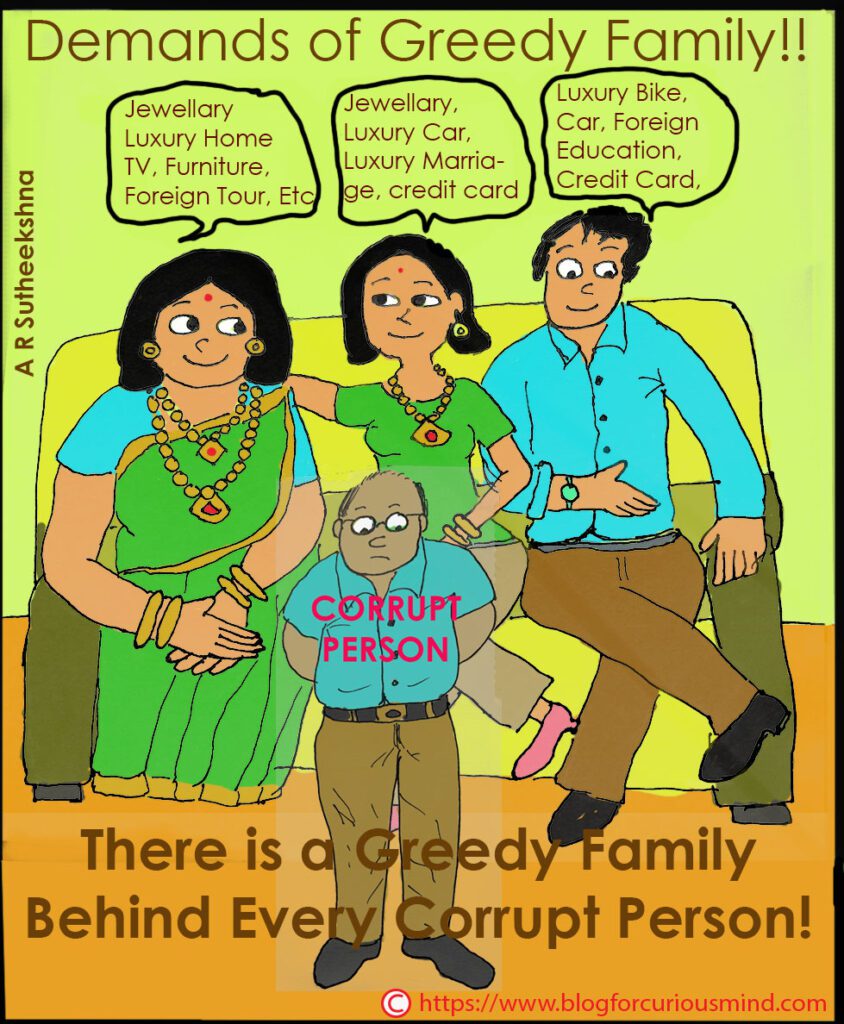
- There is a greedy family behind every corrupt person.
- Many honest persons may be pressured to become corrupt. The pressure may come from family, colleagues, and superiors. You often read in newspapers about an honest officer suffering frequent transfers, and many of these transfers can be to dreaded places. Transfer is a dreaded tool used by superiors to pressurize junior officers to toe their line.
- Lack of transparency is the main cause of corruption. Giving discretionary power to an individual is a major cause of corruption. Corruption can be drastically minimized by enforcing 100 percent transparency, e-governance systems, and zero discretionary powers.
- Weak and unstable governments and authoritative types of governments at the national level give sufficient scope for corruption.
Prevention of corruption
Corruption can be greatly minimized by adopting e-governance and transparent systems in all public and government financial dealings, zero discretionary power, and allowing independent oversight agencies to function without government interference. In India, there are several agencies entrusted with the task of preventing corruption, and important ones are listed below.
- The Prevention of Corruption Act, passed in 1988, defines corruption as a criminal offence. The Central Bureau of Investigation (CBI) is entrusted with the responsibility of investigating corruption cases against central government officers. Please visit https://www.indiacode.nic.in/bitstream/123456789/15302/1/pc_act,_1988.pdf for more.
- The Lokpal and Lokayuktas Act 2013 stipulates the appointment of Lokpal at the National level and Lokayuktas or Anti-corruption agencies at the State level to deal with corruption cases at the National and state levels. Please visit https://dopt.gov.in/sites/default/files/407_06_2013-AVD-IV-09012014_0.pdf and https://en.wikipedia.org/wiki/The_Lokpal_and_Lokayuktas_Act,_2013 for more.
- The Central Vigilance Commission (CVC) is a statutory body created under the act passed by the parliament to administer and monitor vigilance activities for central government establishments, including government of India undertakings and banks. Please visit https://www.cvc.gov.in/ for more.
- The Government of India and State Governments have initiated an e-governance initiative. Now, citizens of India can do their work with the government online. You can do many jobs online, including applying for a driving license, filing Income Tax returns, paying bills, and many more.
- The government has arranged zero-balance bank accounts under Jan Dhan Yojana for poor people, and the eligible beneficiaries of government welfare schemes receive the benefits directly in their bank accounts. This removes the middleman and bribery. Please visit https://www.pmjdy.gov.in/scheme for more.
Conclusion
Corruption is a serious disease, and all of us should participate actively to cure it. If there are no bribe givers, then there cannot be any bribe takers. The state and central governments have implemented e-governance systems to make the system transparent and easy for the beneficiaries. But, corruption cannot be eradicated until every one of us decides not to aspire for things for which a person is legally not eligible.
If you want a driving license, learn to drive, become a pro, and nobody can stop you from getting a driving license. Do not buy a driving license by bribing, it is neither good for you nor for other drivers on the road. This is one example, but this principle can be applied to all of our day-to-day work in public offices. It may be registration of an agreement, obtaining an R C for your vehicle, and so on.
Edits with supporting documents are welcome. Please contact – sutheekshna20256@gmail.com
You may like to read the following articles:
Who elects the Prime Minister of India?
Who elects the President of the United States
Indian PM election v/s American Presidential Election
Animal Logos of American Political Parties
How does the Electoral College work in America
References
https://www.transparency.org/en/what-is-corruption
https://en.wikipedia.org/wiki/Corruption
https://en.wikipedia.org/wiki/Corruption_in_India
https://giaccentre.org/why-corruption-occurs/
https://www.sanctionscanner.com/knowledge-base/corruption-definition-types-causes-1091