
Introduction
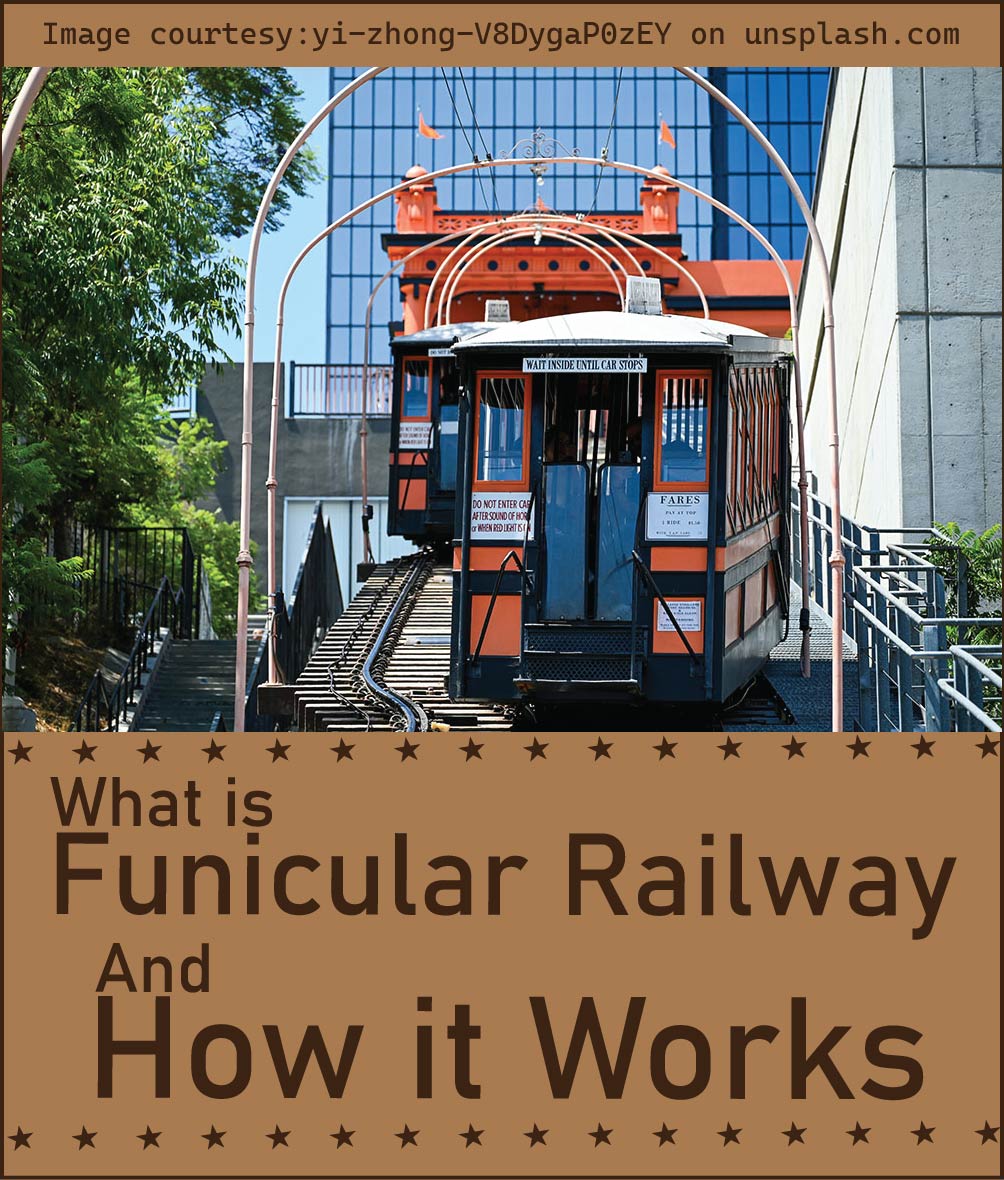
A funicular railway is a railcar designed to travel up and down a steep hill. Normal locomotives cannot climb a steep track since they lose traction. Elevators (lifts) move up and down using a cable, and a normal railcar is pulled by an engine. A funicular railway is a combination of a lift and a railcar. In a funicular railway, the railcar is pulled up the tracks on a hill by a cable. This article explains what is a funicular railway, how it works, a few old funicular railways in the world, and funicular railways in India.
What is a funicular railway?
The origin of the word ‘funicular’ is the Latin word ‘funiculus’, meaning a small rope. So, a railway with its cars pulled by a rope/cable is called a Funicular railway.
Normal railways use steel wheels moving on the tracks, pulled by a locomotive. However, the wheels lose traction when climbing a steep hill. The funicular railway solves this problem by using a cable to pull the railcar, with the wheels acting as a guide.
In a funicular railway, the railcar is hauled by a cable. The hauling cable is guided when the track is curved. The funicular railway helps transport goods and people up and down the steep slope of the hill. The gradient of the funicular railway track can be as high as 48°.
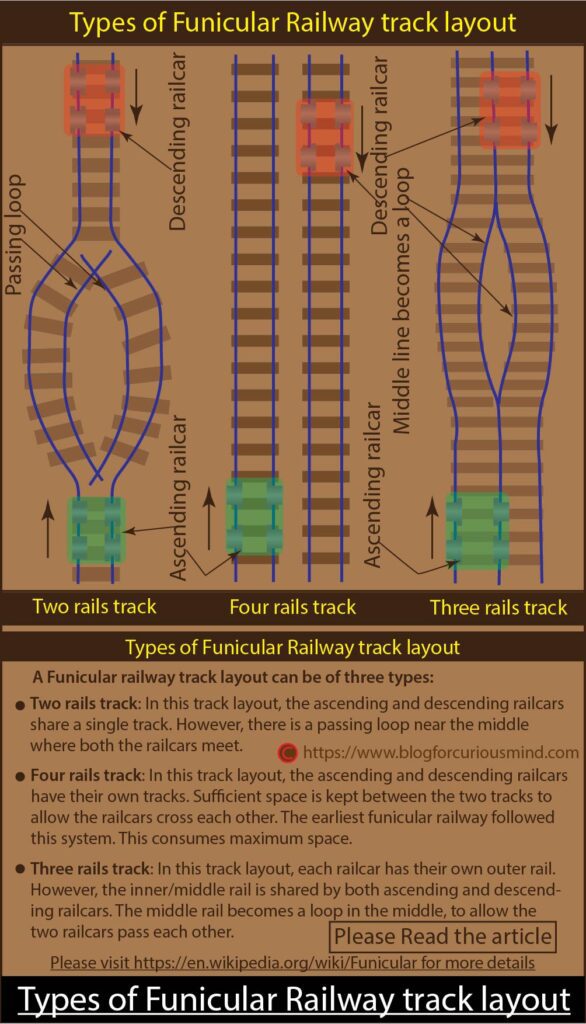
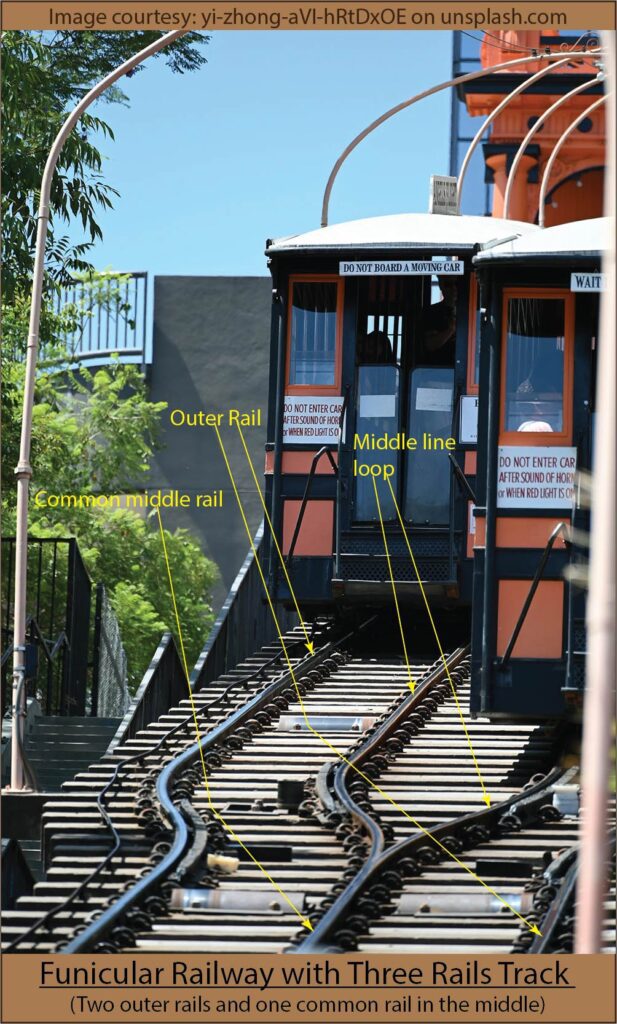
A single track is shared by the ascending and descending railcars. The track splits into two at the meeting point of the two railcars and forms a loop to allow the railcars to pass each other. However, there can also be two independent tracks.
A typical funicular railway consists of two railcars connected by a hauling cable and moves up and down the hill on the track. One car moves up the hill, and the other simultaneously moves downhill. The movement of the up and down railcars is synchronized. The first water-powered funicular railway was built during the last quarter of the 1800s.
Working of a funicular railway
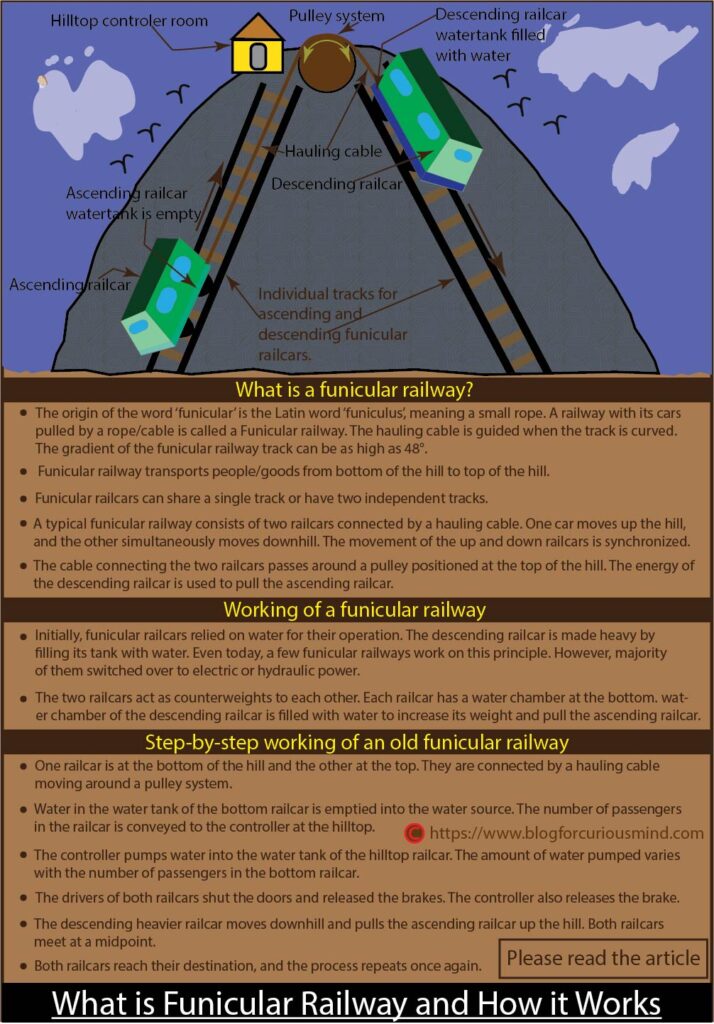
Initially, funicular railcars relied on water for their operation. The descending railcar is made heavy by filling its tank with water. Even today, a few funicular railways work on this principle.
A funicular railway consists of two railcars connected by a hauling cable. The cable connecting the two cars passes around a pulley positioned at the top of the hill. The energy of the descending railcar is used to pull the ascending railcar.
The two railcars act as counterweights to each other. Each railcar has a water chamber at the bottom. The water chamber of the descending car is filled with water to increase its weight and pull the ascending railcar.
Types of funicular railway track layout
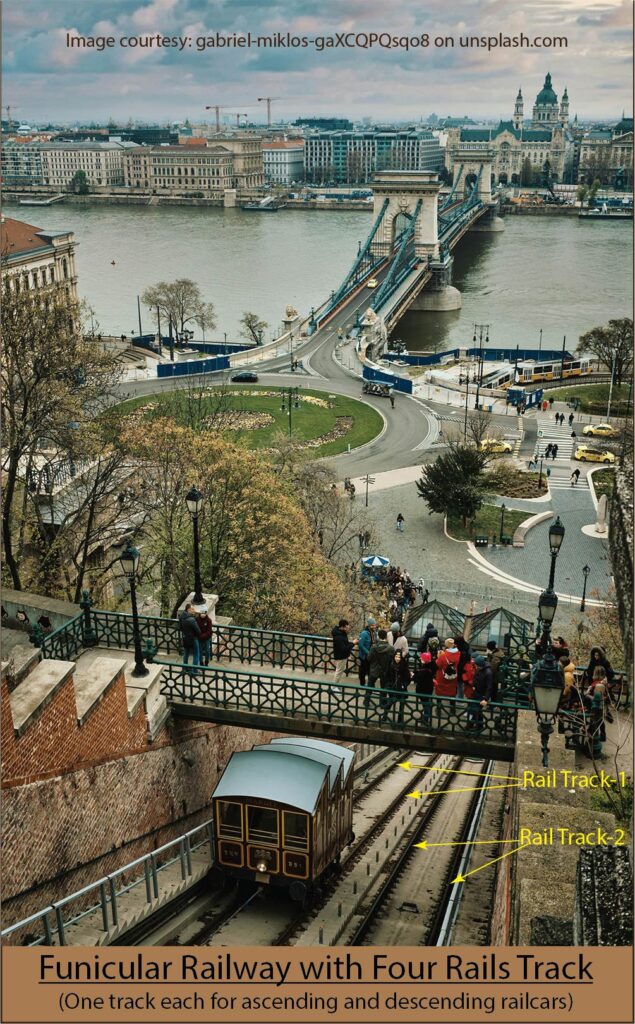
A funicular railway track can be of two rails, three rails, or four rails. The image below explains these track layouts.
Step-by-step working of an old funicular railway
- One railcar is at the bottom of the hill and the other at the top. They are connected by a hauling cable moving around a pulley system.
- Water in the water tank of the bottom railcar is emptied into the water source. The number of passengers in the railcar is conveyed to the controller at the hilltop.
- The controller pumps water into the water tank of the hilltop railcar. The amount of water pumped varies with the number of passengers in the bottom railcar.
- The drivers of both railcars shut the doors and released the brakes. The controller also releases the brake.
- The descending heavier railcar moves downhill and pulls the ascending railcar up the hill. Both railcars meet at a midpoint.
- Both railcars reach their destination, and the process repeats once again.
Developments in funicular railways
As in other fields, funicular railways have undergone modernization. Most of the present-day funicular railway is powered by hydraulic or electric power.
The earlier funicular railway was run by pumping water into the descending railcar chamber to make it heavy and pull the ascending railcar. However, later developments include assisting the ascending railcar with electric traction and establishing a steam engine at the hilltop to pull the railcar with a haul cable.
The present-day funicular railway features a large electric motor located in the hilltop engine room. A reduction gearbox connects the electric motor to a pulley system to handle the haul rope. The engine room has an emergency brake system. Each railcar has its own emergency brakes.
Funicular railway in India
Do you know we have our own funicular railways in India? Yes, the following paragraphs show you where they are.
Haulage trolley at Joginder Nagar, Mandi, Himachal Pradesh
This is the highest funicular railway system in India at 2530 meters (8300 feet) above sea level. This was built in 1930 for hauling heavy machinery for building a power house. The length of this funicular railway track is 4 kilometers and is operated in 4 stages. Please visit https://en.wikipedia.org/wiki/Joginder_Nagar_Valley for more details. You may view this YouTube video.
Saptashrungi funicular trolley
Saptashrungi Devi Temple is a hilltop temple in Nashik, Maharashtra. This temple hill has 550 steps to climb. But you can reach the hilltop in 3 minutes by riding a funicular trolley.
Yes, this is the first passenger funicular trolley in India and has been in service since 2018. It can accommodate 60 passengers and costs INR 80 for a round trip. The funicular railcar climbs a steep 36° incline. Please visit https://en.wikipedia.org/wiki/Saptashrungi for more. You may view this YouTube video.
Funicular railway at Jivdani Mata Devi Temple, Virar, Maharashtra
This is the second Funicular passenger railway in Maharashtra and India. Jivdani Mata Devi Temple is a hilltop temple in Virar, Maharashtra. You can climb 1465 steps and take the darshan of Jivdani Mata Devi. Alternatively, you can hop into a funicular railcar.
This funicular railcar has been in service since 2021. The funicular railcar can accommodate up to 104 passengers, and the journey time is 7 minutes. A round trip will cost you INR 200. You may view this YouTube video.
Winch train at Dhandayuthapani Temple, Palani, Tamil Nadu.
The Dhandayuthapani Temple at the Palani Hills, Palani, Tamil Nadu, is a temple dedicated to Lord Murugan. You can climb 690 steps and take the darshan of Lord Murugan. Alternatively, you can hop into a winch train and reach the temple within 10 minutes.
The winch railcar can accommodate about 50 passengers, and the travel time can be 8 minutes. You may view this YouTube video.
Malang Gad Funicular Railway, near Kalyan, Maharashtra
This is the latest addition to the Funicular Railways in India. At 1.2 KM, it is the longest Funicular Railway in India. It reduces a two-hour, grueling 2600 steps journey by foot to 10 minutes comfortable journey in a Funicular car.
This Funicular Railway has been open to the public since 20th January 2026. Each trip can carry 120 passengers, and a round ticket costs INR 150. This will be a boon for senior citizens visiting the shrine. You may watch this YouTube video.
A few old funicular railways in the world
A few old funicular railways that are still operational are compiled below.
Monongahela Incline
The Monongahela Incline is a funicular railway located in Pittsburgh, Pennsylvania, United States. This funicular railcar has been operational since 1870 and has transported people from the workplace at the base to their residential area on Mt. Washington.
The length of this funicular track is 194 meters (635 feet), and the incline has an approximate gradient angle of 35°. The track is broad gauge, and the railcar can carry 23 passengers.
Saltburn Cliff Lift
The Saltburn Cliff Lift is a funicular railway located in North Yorkshire, England. It connects the Saltburn pier to the town. This was built in 1884 and is the oldest funicular railway in the United Kingdom that uses water ballast.
Each railcar is fitted with a 1100-liter water tank, and the descending car filled with water pulls the ascending railcar. The track length is 63 meters (207 feet) and has a maximum gradient of 35°.
Bergamo funicular railway
This funicular railway is located in Bergamo, Italy, and connects the upper and lower cities. This was built in 1887 and is still operational. The length of the right track is 240 meters (787 feet), and the length of the left track is 234 meters (768 feet). Please visit https://en.wikipedia.org/wiki/Bergamo_Funicular_railway_Upper_Town_-_Lower_Town for more.
Burgenstock Funicular
The Burgenstock Funicular railway is located in the canton of Nidwalden, Switzerland. It connects the Kehrsiten Burgenstock with the Burgenstock resort. This funicular was opened in 1888 and was operational till 2011. It was renovated and reopened in 2017.
The track length is 929 meters (3048 feet) and the maximum gradient is 30°. Journey time is 4 minutes. Please visit https://en.wikipedia.org/wiki/B%C3%BCrgenstock_Funicular for more.
Nerobergbahn funicular railway
This funicular railway is located in Wiesbaden, the capital of the German state of Hesse. It was opened in 1888 and ran using water ballast to increase the weight of the descending railcar. The funicular railway ceased operation in 1944 due to war-related damage.
The funicular railway was upgraded and reopened in 1948. The track length is 440 meters (1444 feet) and the average gradient of the incline is 11°. The journey time is 3.5 minutes. Please visit https://en.wikipedia.org/wiki/Nerobergbahn for more.
Peak Tram
The Peak Tram is a funicular railway in Hong Kong that transports tourists and residents to the upper levels of Hong Kong Island. This is the first funicular railway in Asia and has been operational since 1888.
The length of this funicular track is 0.84 miles (1.35 kilometers), and the gradient angle ranges from 4° to 27°. It has two railcars with a passenger capacity of 210 per trip. Please visit https://en.wikipedia.org/wiki/Peak_Tram for more.
Funiculaire de Thonon-les-Bains
The Funiculaire de Thonon-les-Bains is a funicular railway in Thonon-les-Bains, France. It connects Belvedere in the city center to the port of Rives. This funicular railway was started in 1888 and renovated in 1951 and 1989.
The funicular track length is 243 meters (797 feet), and the average gradient is 12°. The passenger capacity is 54, and the trip time is 1.5 minutes. Please visit https://en.wikipedia.org/wiki/Funiculaire_de_Thonon-les-Bains for more.
Hornblower Niagara Funicular, previously known as Maid of the Mist Incline.
This is in the city of Niagara Falls, Ontario, Canada. The Maid of the Mist funicular railway was originally built in 1894 for transporting the Maid of the Mist boat tour passengers from Clifton Hill foot to the dock below.
The funicular rail track was 50 meters (164 feet) long. It consisted of two 12-seater railcars hauled by electric power.
This funicular railway was developed and rebuilt in 1977 and 2019 to ferry the passengers for the boat tour. Please visit https://en.wikipedia.org/wiki/Hornblower_Niagara_Funicular for more.
Lookout Mountain Incline Railway
The Lookout Mountain Incline Railway is a standard-gauge funicular railway located in Chattanooga, Tennessee, United States. It transports the passengers from the St. Elmo base station to the hilltop of Lookout Mountain.
This funicular railway track length is 1 mile (1.6 kilometers) and has been operational since 1895. It was upgraded and modernized from time to time to make it passenger safe. Please visit https://en.wikipedia.org/wiki/Lookout_Mountain_Incline_Railway for more.
Angels Flight funicular
Angels Flight is a narrow-gauge funicular railway at Bunker Hill, Los Angeles, California, USA. The length of this funicular rail track is 91 meters (298 feet). It was built to connect Hill Street and Olive Street and was operational from 1901 to 1969. After 1969, it was opened and closed several times. It was renovated in 2017 to include safety features and is now operational, with slight modifications to the connecting points. Please visit https://en.wikipedia.org/wiki/Angels_Flight for more.
Reina Victoria Lift (funicular)
Reina Victoria funicular is located in Valparaiso, Chile. The Reina Victoria funicular has been in service since 1903, and connects Elias Street to Paseo Dimalow. Please visit https://en.wikipedia.org/wiki/Reina_Victoria_lift for more.
Takao Tozan Cable
The Takao Tozan Cable Funicular Railway in Japan. It transports the passengers to Mount Takao and has been operational since 1921.
The funicular rail track length is 0.6 miles (1 kilometer), and the gradient is 31°. The ride time is 5 minutes. Please visit https://en.wikipedia.org/wiki/Takaotozan_Railway for more.
Vladivostok Funicular
The Vladivostok Funicular is located in Vladivostok, Russia. This has been operational since 1962. The length of this funicular rail track is 183 meters (600 feet), and the journey time is 1.5 minutes. Please visit https://vladivostok.travel/en/todo/funicular/ for more.
Falls incline railway, Canada
The Falls incline railway is a funicular railway at Niagara Falls, Ontario, Canada. This was originally built in 1966, and later modernized to operate it during all seasons. Please visit https://en.wikipedia.org/wiki/Falls_Incline_Railway for more.
In other places
Odesa funicular, Ukraine (since 1902), Aberystwyth cliff railway, Wales (since 1896), and Wellington Cable Car, New Zealand (since 1902).
Please visit https://en.wikipedia.org/wiki/List_of_funicular_railways for an exhaustive list of funicular railways in the world.
Why is it called a funicular railway?
The word ‘funicular’ originates from the Latin word ‘funiculus’, meaning a small rope. So, a railway with its cars pulled by a rope/cable is called a Funicular railway.
Conclusion
A funicular railway is fun to know and fun to ride. The short ride shows you the panoramic view of the nature surrounding the mountain. Do not forget to ride the funicular railcar during your next trip to Mumbai (Virar) and Nashik and receive the blessings of the Devi. Please visit https://en.wikipedia.org/wiki/Funicular for more details on a funicular railway.
You may watch these 4 YouTube videos: Video1, Video2, Video3, and Video4.
You may read the following articles: