
Introduction
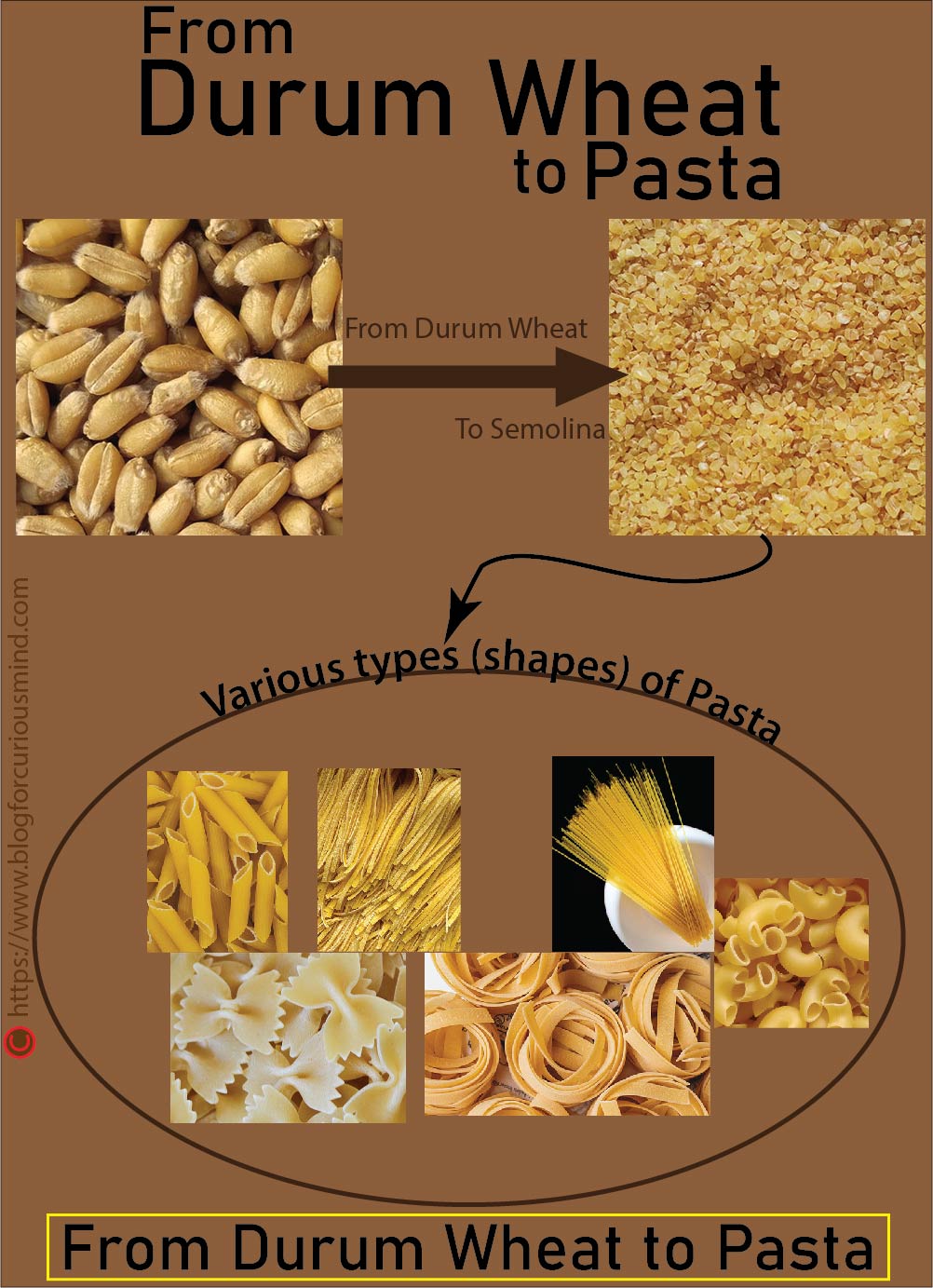
Italy is the birthplace of pasta. What started in the homes of Italy more than a century ago, pasta is now manufactured in high-tech factories using state-of-the-art technology. The pasta factories utilize advanced technology to convert durum wheat into mouthwatering pasta. It will be interesting to understand how pasta is made in a factory.
Today, pasta is made in many countries and consumed all over the world. Modern pasta factories run completely automated continuous production lines with minimum human intervention. Pasta is made in over 350 varieties of shapes, including fusilli, penne, farfalle (bow tie), and of course, the legendary spaghetti.
In the culinary world, pasta is known as soft gold. Today, it is a $80 billion industry worldwide.
What is pasta
Pasta is a type of food made using durum wheat semolina dough. The durum wheat semolina dough is converted into many shapes using dies, rollers, a press, or manually. The shapes are dried to bring down the moisture level to 12 to 12.5 percent. The dried pasta can be cooked in boiling water and eaten with sauces. Choice of cooked vegetables or meat can be added.
Italy is the home of pasta. However, it is not self-sufficient in its main ingredient, durum wheat. Italy imports durum wheat from many places, including Canada, the United States, and Australia.
How pasta is made in a factory
The process of making pasta in a factory starts with durum wheat and ends with neatly packed and labeled pasta. Durum wheat is a hard variety of wheat preferred for pastas due to its high content of protein and strong gluten. The dough made of durum wheat semolina is strong and malleable, and suitable for extrusion of different shapes of pasta. Pastas made from durum wheat semolina dough retain their shape well during cooking.
The machinery used in a pasta making factory are made with highest care of hygiene and health. The parts coming in contact with food are made from stainless steel or equivalent food grade material.
Durum wheat is converted into pasta in the following steps:
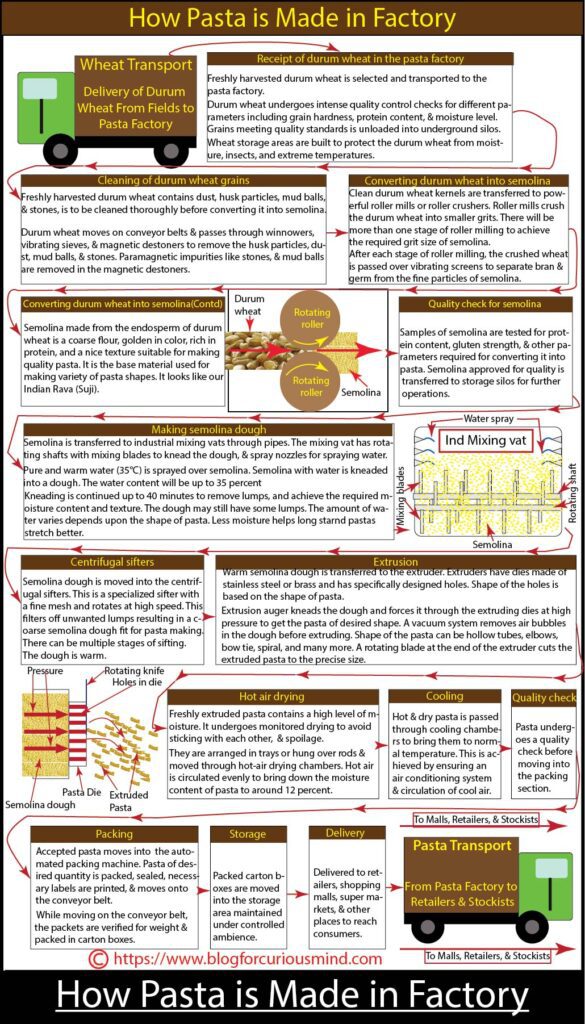
Step 1: Receipt of durum wheat in the pasta factory
The freshly harvested durum wheat is selected and transported to the pasta factory.
Durum wheat undergoes intense quality control checks for different parameters, including grain hardness, protein content, and moisture level. The grains meeting the quality control standards are unloaded into huge underground silos.
The wheat storage areas are built to protect the durum wheat from moisture, insects, and extreme temperatures.
Step 2: Cleaning of durum wheat grains
The freshly harvested durum wheat contains dust, husk particles, mud balls, and stones, and is to be cleaned thoroughly before converting it into semolina.
The durum wheat moves on conveyor belts and passes through winnowers, vibrating sieves, and magnetic destoners to remove the husk particles, dust, mud balls, and stones. Paramagnetic impurities like stones and mud balls are removed in the magnetic destoners.
This YouTube video explains a magnetic destoning machine.
Step 3: Converting durum wheat into semolina
The clean durum wheat kernels are transferred to powerful roller mills or roller crushers. The roller mills crush the durum wheat into smaller grits. There will be more than one stage of roller milling to achieve the required grit size of semolina.
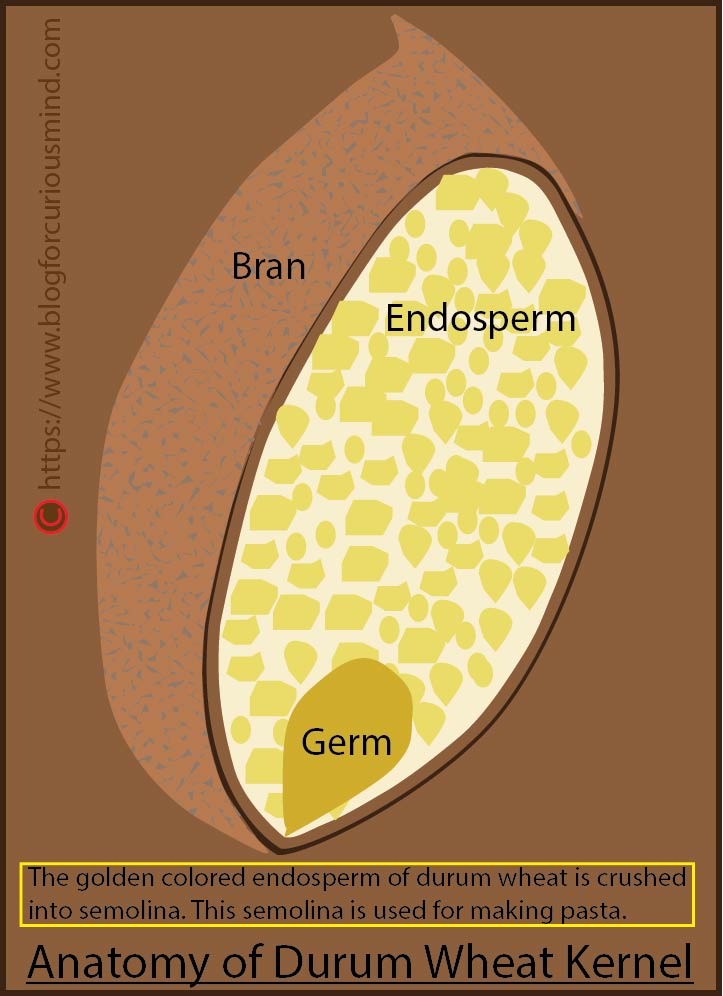
After each stage of roller milling, the crushed wheat is passed over vibrating screens to separate bran and germ from the fine particles of semolina (endosperm of durum wheat).
The semolina made from the endosperm of durum wheat is a coarse flour, golden in color, rich in protein, and has a nice texture suitable for making quality pasta. Semolina is the base material used for making a variety of pasta shapes. It looks like our Indian Rava (Suji).
Step 4 Quality check for semolina
Samples of semolina are tested for protein content, gluten strength, and other parameters required for converting it into pasta. Semolina approved for quality is transferred to storage silos for further operations.
Step 5: Making semolina dough
Semolina is transferred to huge industrial mixing vats through pipes. The mixing vat has rotating shafts with mixing blades to knead the dough, and spray nozzles for spraying water. Pure and warm water (around 35°C) is sprayed over semolina. Semolina with water is kneaded into a dough. The water content will be up to 35 percent.
The kneading is continued up to 40 minutes to remove lumps and achieve the required moisture content and texture. The dough may still have some lumps. The amount of water varies depending on the shape of the pasta. Less moisture content in the dough helps long strands of pasta stretch better.
Step-6 Centrifugal sifters
The semolina dough is moved over conveyor belts into the centrifugal sifters. This is a specialized sifter with a fine mesh and rotates at high speed. These filter out unwanted lumps, resulting in a coarse semolina dough fit for pasta making. There can be multiple stages of sifting to achieve a semolina dough with uniform texture. The dough is warm.
Step-7 Extrusion
The warm semolina dough is transferred to the extruder. Extruders have dies made of stainless steel or brass and have specifically designed holes. The shape of the holes is based on the shape of pasta.
The extrusion auger kneads the dough and forces it through the extruding dies at high pressure to get the pasta of the desired shape. A vacuum system removes air bubbles in the dough before extruding. The shape of the pasta can be hollow tubes, elbows, bow ties, spirals, and many more. A rotating blade at the end of the extruder cuts the extruded pasta to the precise size.
Note: The cutting system for spaghetti will be different from the above. In the case of tagliatelle (long ribbon-shaped pasta), the dough is rolled into a thin sheet, the edges are trimmed, slit into ribbons, and cut to the desired length.
Step 8 Hot air drying
Freshly extruded pasta contains a high level of moisture. It must undergo a monitored drying process to avoid them sticking with each other, spoilage, and enhance shelf life.
Based on the type of pasta, they are arranged in trays or hung over rods (for spaghetti) and moved through hot-air drying chambers. Hot air is circulated evenly to bring down the moisture content of pasta to around 12 percent.
Step-9 Cooling
The hot and dry pasta is passed through cooling chambers to bring it to normal temperature. This is achieved by ensuring an air conditioning system and the circulation of cool air.
Step-10 Quality check
The pasta undergoes a quality check before moving into the packing section.
Step-11 Packing
The accepted pasta moves into the automated packing machine. The pasta of the desired quantity is packed, sealed, and the necessary labels are printed, and it moves onto the conveyor belt.
While moving on the conveyor belt, the packets are verified for weight and packed in carton boxes.
Step-12 Storage
The packed carton boxes are moved into the storage area maintained under controlled conditions.
Step-13 Delivery
Delivered to retailers, shopping malls, supermarkets, and other places to reach consumers.
You may view these three YouTube videos to see how durum wheat is converted to pasta. Video 1, Video 2, and Video 3.
Types (shapes) of pasta
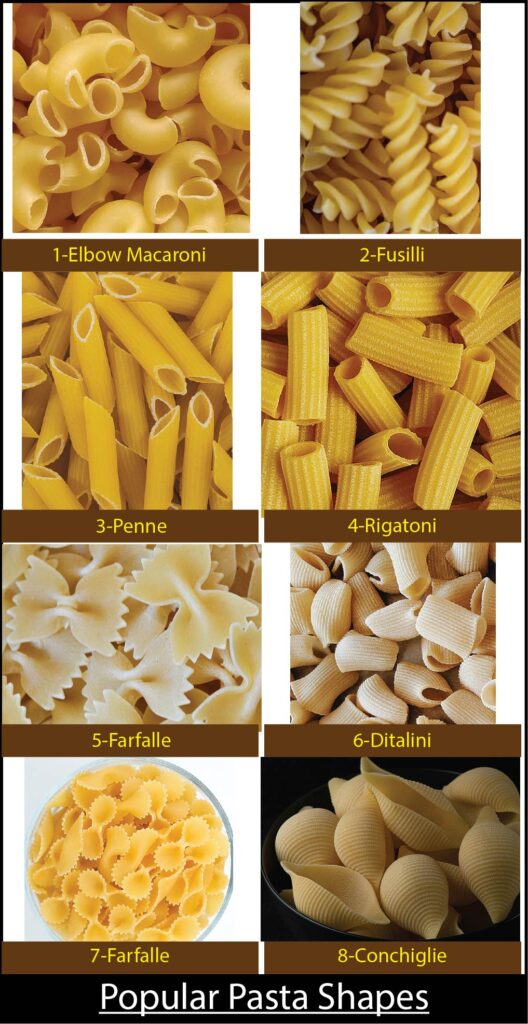
Even though the basic raw material used for making durum wheat pasta is ‘durum wheat semolina’, pasta is made in different shapes. And, there is a name for each type/shape of pasta. All the pasta shapes generally fall into one of the following two categories.
Category I: Semolina dough extruded or pressed into different shapes of small dimensions. Examples of this category are:
- Elbow Macaroni (Maccheroni)
- Fusilli
- Penne
- Rigatoni
- Farfalle
- Ditalani
- Conchiglie
Category II: Semolina dough extruded into long strands of different cross-sections is included in this category. You can call these long pasta shapes. Examples of this category are:
- Spaghetti
- Trenette
- Tagllatelle
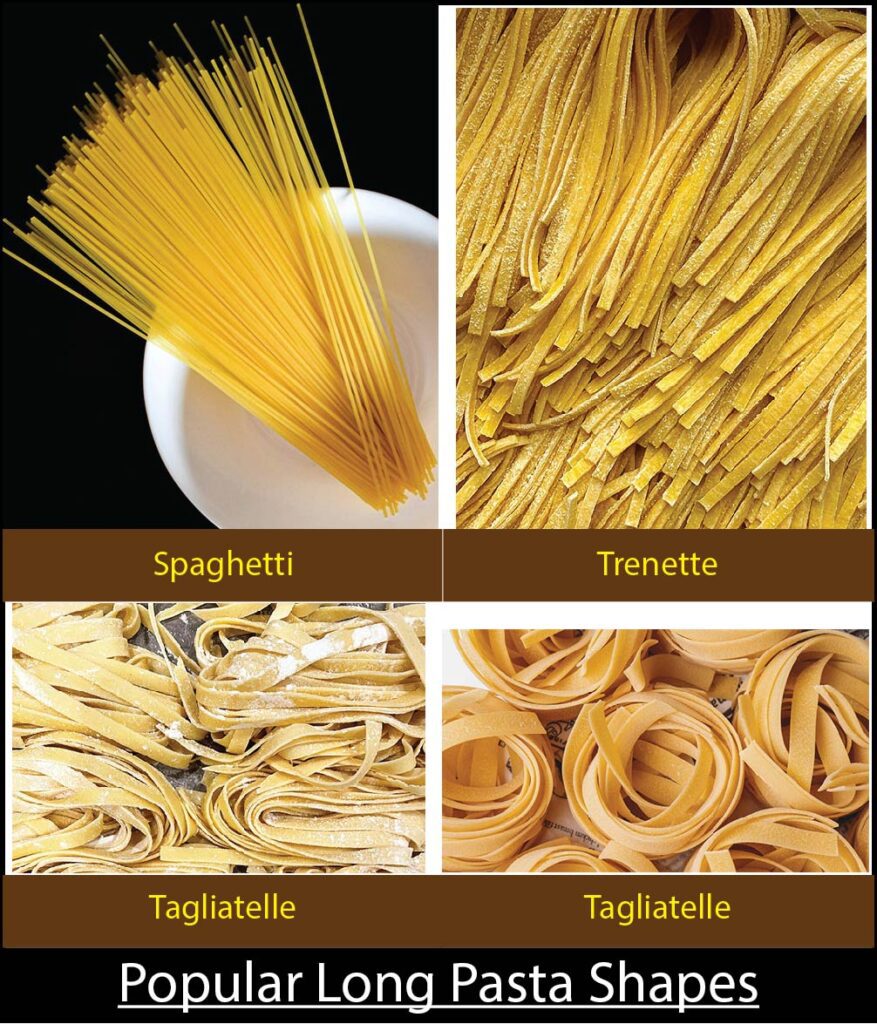
Two of the popular long pasta shapes, Spaghetti and Tagliatelle, are briefly explained in the following headings.
Spaghetti
Spaghetti is a popular type of pasta and is relished by people around the world. Spaghetti is long, round, and slender strands of pasta made from durum wheat semolina. The diameter of spaghetti strands can be 1.5 to 2 millimeters, and the length 25 to 30 centimeters.
The extruded spaghetti is neatly hung in stacks on a rod and moved through a hot air drying chamber and an air-conditioned cooling chamber.
The dry and cool spaghetti is transferred into the automatic packing machines and packed in desired weights. The packs are printed with labels, checked for weight, packed in cartons, and moved into the storage area ready for shipping.
Tagliatelle (flat ribbons of pasta)
Tagliatelle is a pasta shaped as flat ribbons. The semolina dough is rolled into sheets of designed thickness, width, and running length. The edges (left and right) of the moving sheet are trimmed. The width of the moving sheet is slit into uniform-width ribbons and cut to the required length. The cut ribbons fall into trays.
The ribbons are dusted with flour to avoid them sticking together. The trays of Tagliatelle pasta go through the hot air-drying chamber, cooling chamber, automatic packing system, and are transferred to the storage area.
How to cook pasta
Pasta is fairly easy to cook, even for new entrants to the culinary field. Many pasta manufacturers give cooking instructions on the package. The instructions are simple. Just follow the instructions, cook the pasta, and relish relaxingly. If you are pressed for time, there are instant pastas for you.
Pasta goes very well with most green vegetables. It may go well with meat also. But I have no idea since I am a vegetarian. Heat little oil on a concave griddle (kadai) and temper (Thadka in Hindi) with mustard or cumin seeds. Fry your choice of cut vegetables, add your favorite masala powder, salt to taste, add pasta, water, and cook for 10 to 12 minutes. Your pasta meal is ready.
Conclusion
Pasta made from durum wheat semolina can be a healthy choice. You have the advantage of cooking pasta with many fresh vegetables to make it a wholesome meal. Hope this article was able to answer many of your questions on pasta. You can search YouTube for healthy and simple pasta recipes.
Edits with supporting documents are welcome. Please mail me at sutheekshna20256@gmail.com
Note
Every individual has their own health, allergy, and other issues. If you are new to pasta, seek the advice of your doctor before adding pasta to your diet. Please read the ingredient content and allergen cautions on the package carefully.
You may want to read the following articles:
Health Benefits of Eating Roasted Chana
What is Sabudana and how it is made in India
How Poha is made from rice (paddy)
Nutrients and Vitamins in Cornflakes
How Murmura or Puffed Rice is made from Rice
How Ragi Huri Hittu or Popped Ragi Powder is Made
Roasted Chana Manufacturing Process
References
https://en.wikipedia.org/wiki/Pasta_processing
https://www.favastorci.com/fava_storci_page.asp?pid=1034&lang=EN