
Introduction
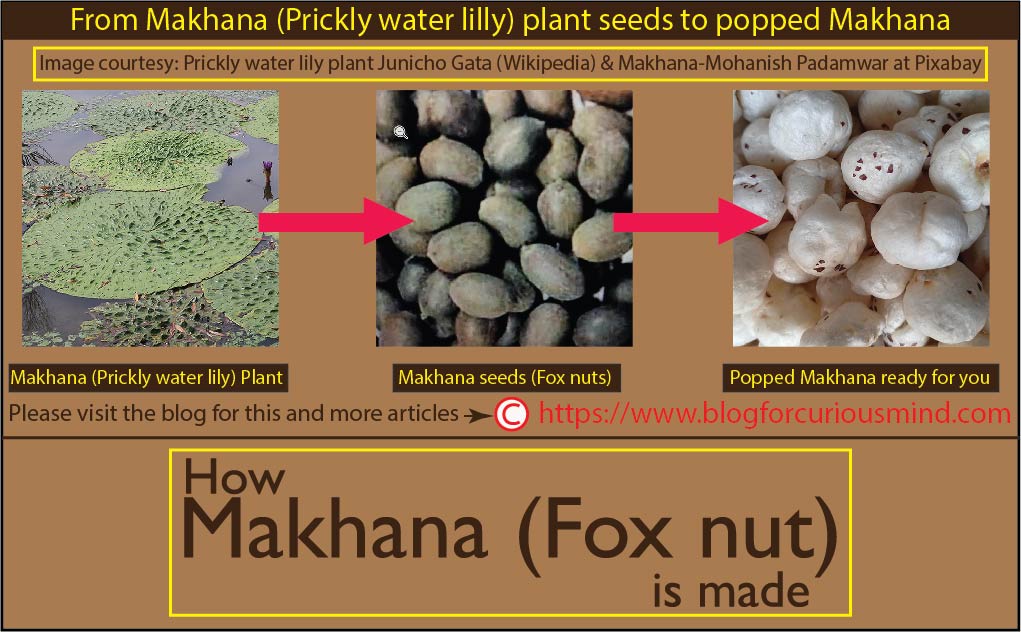
Makhana is the popular Hindi name for Fox nuts in India. When translated to English, it means Fox nut, Gorgon nut, or prickly water lily seeds. Though Makhana is a seed, for the general public, Makhana implies ‘popped Makhana seed (Fox nut)’. India is the largest cultivator and supplier of Makhana to the international market. China cultivates and uses Makhana (Fox nuts) in medicine. This article explains to you how Makhana (Fox nut) is made. I will cover from harvesting to popping and packing Makhana.
Small brief about Makhana (Fox nut)
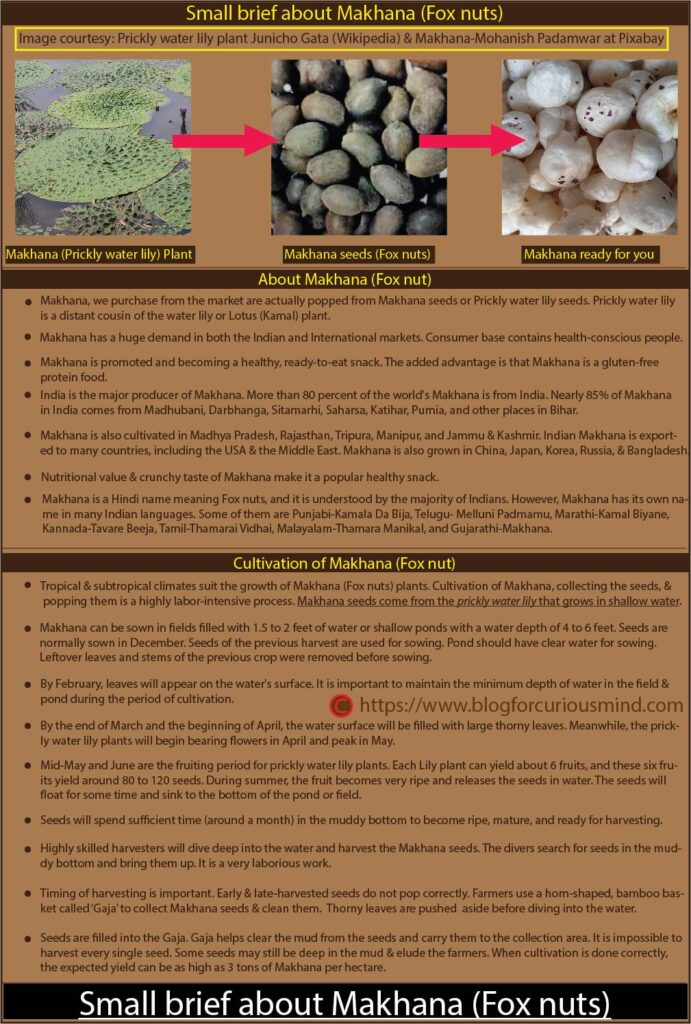
The Makhana (Fox nuts) we purchase from the market are actually popped from Makhana seeds (Fox nuts). Makhana has a huge demand in both the Indian and International markets. The consumer base contains health-conscious people.
Makhana is promoted and becoming a healthy, ready-to-eat snack. The added advantage is that Makhana is a gluten-free protein food. However, the high cost of Makhana makes it unaffordable to the majority of people.
India is the major producer of Makhana (Fox nut). Presently, more than 80 percent of the world’s Makhana is from India. Bihar is the principal producer of Makhana. Nearly 85% of Makhana in India comes from Madhubani, Darbhanga, Sitamarhi, Saharsa, Katihar, Purnia, and other places in Bihar.
Makhana is also cultivated in Madhya Pradesh, Rajasthan, Tripura, Manipur, and Jammu and Kashmir. Indian Makhana is exported to many countries, including the USA and the Middle East. Makhana is also grown in China, Japan, Korea, Russia, and Bangladesh.
When the seeds of the prickly water lily plant are popped, they are called Makhana or Fox nut. The nutritional value and crunchy taste of Makhana make it a popular healthy snack. Prickly water lily is a distant cousin of the water lily or Lotus (Kamal) plant.
Makhana is a Hindi name meaning Fox nuts, and it is understood by the majority of Indians. However, Makhana has its own name in many Indian languages. Some of them are Punjabi-Kamala Da Bija, Telugu- Melluni Padmamu, Marathi-Kamal Biyane, Kannada-Tavare Beeja, Tamil-Thamarai Vidhai, Malayalam-Thamara Manikal, and Gujarathi-Makhana.
Cultivation of Makhana (Fox nut)
Tropical and subtropical climates suit the growth of Makhana (Fox nuts) plants. Cultivation of Makhana, collecting the seeds, and popping them is a highly labor-intensive process. Makhana seeds come from the prickly water lily that grows in shallow water.
Makhana can be sown in fields filled with 1.5 to 2 feet of water or shallow ponds with a water depth of 4 to 6 feet. Seeds are normally sown in December. The seeds of the previous harvest are used for sowing. The pond should have clear water for sowing. The leftover leaves and stems of the previous crop were removed before sowing.
By February, leaves will appear on the water’s surface. It is important to maintain the minimum depth of water in the field and pond during the period of cultivation.
By the end of March and the beginning of April, the water surface will be filled with large thorny leaves. Meanwhile, the prickly water lily plants will begin bearing flowers in April and peak in May.
Mid-May and June are the fruiting period for prickly water lily plants. Each Lily plant can yield about 6 fruits, and these six fruits yield around 80 to 120 seeds. During summer, the fruit becomes very ripe and releases the seeds in water. The seeds will float for some time and sink to the bottom of the pond or field.
The seeds will spend sufficient time (around a month) in the muddy bottom to become ripe, mature, and ready for harvesting.
Highly skilled harvesters will dive deep into the water and harvest the Makhana seeds. The divers search for seeds in the muddy bottom and bring them up. It is a very laborious work.
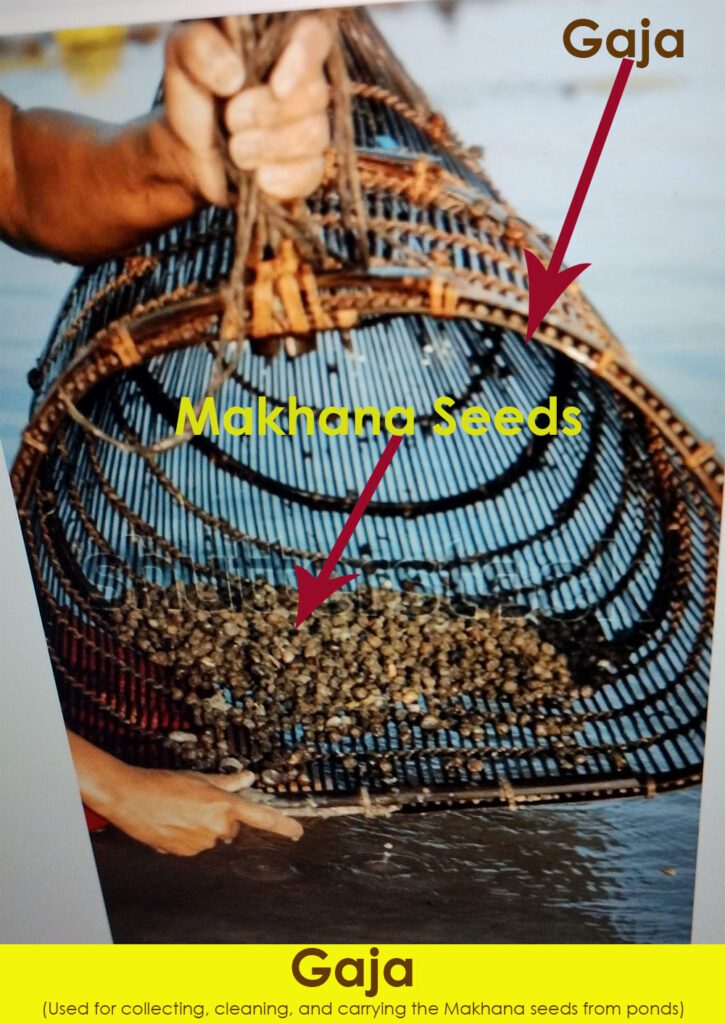
The timing of harvesting is important. Early and late-harvested seeds do not pop correctly. The farmers use a horn-shaped, bamboo basket called ‘Gaja’ to collect Makhana seeds and clean them. It is important to push the thorny leaves aside before diving into the water.
The seeds are filled into the Gaja. Gaja helps clear the mud from the seeds and carry them to the collection area. During the initial days of harvesting, farmers collect 100 to 200 kgs of seeds per day. However, the yield reduces gradually, and it is impossible to harvest every single seed. Some seeds may still be deep in the mud and elude the farmers. When cultivation is done correctly, the expected yield can be as high as 3 tons of Makhana per hectare.
How Makhana (Fox nut) is made
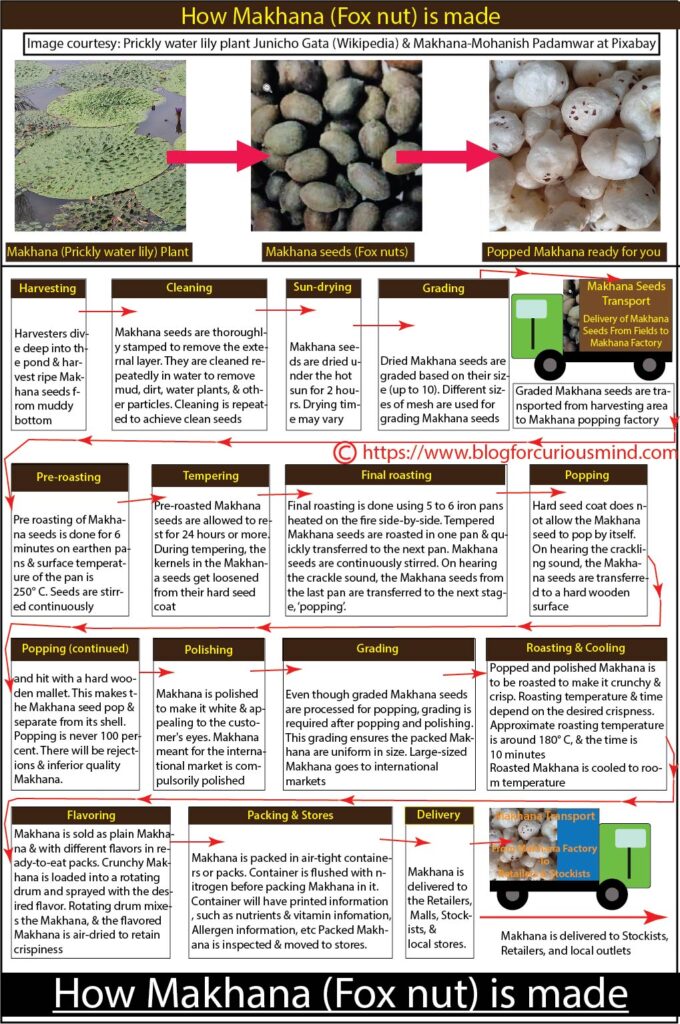
Cleaning
The Makhana seeds are thoroughly stamped to remove the external layer. They are loaded into the Gaja and cleaned again in water to remove mud, dirt, water plants, and other particles. The cleaning process must be repeated to achieve the desired quality of seeds. Clean seed is the first step in ensuring quality Makhana.
Sun-drying
The Makhana seeds are dried under the hot sun for two hours. Drying time and the quality of drying influence the popping of Makhana seeds.
Grading
The dried Makhana seeds are graded based on their size, and the number of sizes can be up to 10. Different sizes of mesh are used for grading Makhana seeds.
Pre-roasting
Pre-roasting of Makhana seeds (Fox nuts) is normally done on earthen pans. The surface temperature of the pan is 250° Celsius. The fragile Makhana will not tolerate high temperatures. The Makhana seeds are pre-roasted for about 6 minutes, and they are stirred continuously. Pre-roasting is the base for good popping. The hard shell will get ready to pop.
Tempering
The pre-roasted Makhana seeds are allowed to rest in a specially maintained tempering space for 24 hours or more. During tempering, the kernels in the Makhana seeds get loosened from their hard seed coat.
Final roasting
Iron pans are used for final roasting. Final roasting is done using 5 to 6 iron pans heated on the fire side-by-side. Tempered Makhana seeds are roasted in one pan and quickly transferred to the next pan. Makhana seeds are continuously stirred. On hearing the crackle sound, the Makhana seeds from the last pan are transferred to the next stage, ‘popping’.
Popping
The hard seed coat does not allow the Makhana seed to pop by itself. On hearing the crackling sound, the Makhana seeds are transferred to a hard wooden surface and hit with a hard wooden mallet. This makes the Makhana seed pop and separate from its shell. This is a high-skilled job and needs experience, concentration, and stamina to do it continuously. The popping is never 100 percent. There will be rejections and inferior quality Makhana.
Polishing
The Makhana is polished to make it white and appealing to the customer’s eyes. Makhana meant for the international market is compulsorily polished.
Grading
Even though graded Makhana seeds (Fox nuts) are processed for popping, grading is required after popping and polishing. This grading ensures the packed Makhana are uniform in size. Large-sized Makhana goes to international markets.
Roasting
The popped and polished Makhana is to be roasted to make it crunchy and crisp. This can be done manually or on a rotary roaster. The roasting temperature and time depend on the desired crispness. The approximate roasting temperature is around 180° C, and the time is 10 minutes.
Cooling
Roasted Makhana is cooled to room temperature.
Flavoring
Makhana is sold as plain Makhana and with different flavors in ready-to-eat packs. The crunchy Makhana is loaded into a rotating drum and sprayed with the desired flavor. The rotating drum mixes the Makhana, and the flavored Makhana is air-dried to retain crispiness.
Packing
The Makhana is packed in air-tight containers or packs. The container is flushed with nitrogen before packing Makhana in it. The container will have printed information, such as nutrients and vitamin information, Allergen information, etc.
When exposed to air, Makhana can absorb moisture present in the air (it is hygroscopic). Nitrogen packing is normally used to maintain the freshness and crispness of packed Makhana.
Delivery
Makhana is delivered to the Retailers, Malls, Stuckists, and local stores.
You may view this and this YouTube videos.
Mechanization in Makhana making
Machineries have been developed for mechanizing the manual processes of making Makhana. However, Makhana making process in India is predominantly a manual process. The advantage is it provides employment to local people, especially women.
Health benefits of Makhana
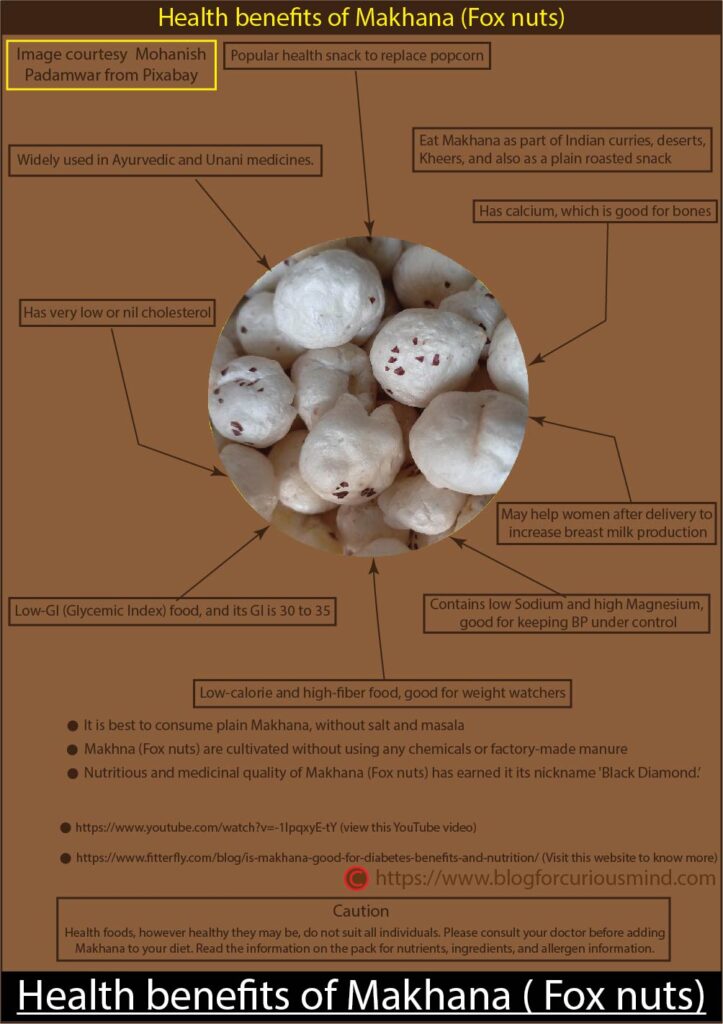
Makhana has health benefits, and some of them are listed below.
- Makhana seeds are widely used in Ayurvedic and Unani medicines.
- You can eat Makhana as part of Indian curries, deserts, Kheers, and also as a plain roasted snack.
- It is a popular health snack to replace popcorn.
- Makhana has very low or nil cholesterol.
- Contains low Sodium and high Magnesium, which is good for keeping blood pressure under control.
- Makhana is a low-GI (Glycemic Index) food, and its GI is 30 to 35. It can be a healthy between-meals snack for people with diabetes. Consume it moderately.
- Makhana may help women after delivery to increase breast milk production.
- Makhana is a low-calorie and high-fiber food, good for weight watchers.
- Makhana has calcium, which is good for bones.
- It is best to consume plain Makhana, without salt and masala.
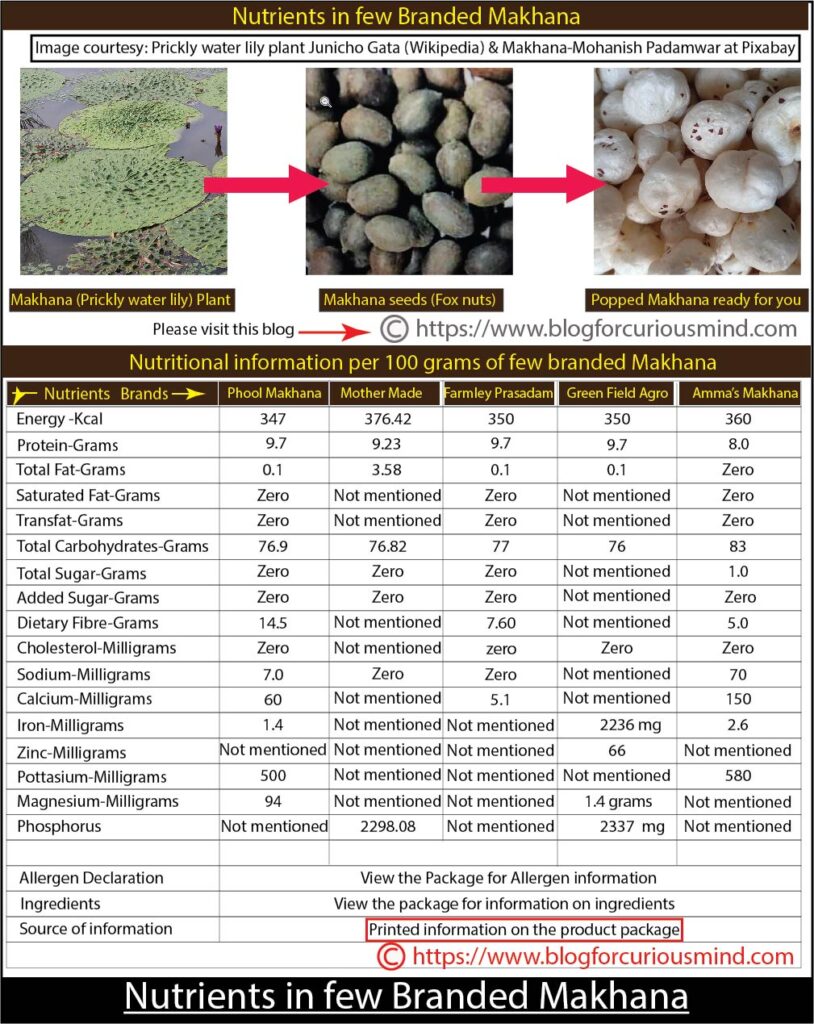
Makhna (Fox nuts) are cultivated without using any chemicals or factory-made manure. Nutritious and medicinal quality of Makhana (Fox nuts) has earned it its nickname ‘Black Diamond.’ The following image gives you compiled nutrition information of a few branded Makhana.
You can view this YouTube video if you like.
Why is Makhana so costly?
Major reasons for the high cost of Makhana are as follows.
- Cultivating Makhana seeds and popping is a highly labor-intensive process. The process is mostly done manually even today. Labor is costly.
- The yield of Makhana seeds per hectare is moderate. This increases the cost of Makhana seeds.
- Not all Makhana seeds pop. Not popped Makhana seeds become waste. This increases the cost of popped Makhana.
- There are different grades of Makhana. Lower grades of Makhana cost less. They are small in size but will contain most of the Makhana’s goodness.
Conclusion
Did you know how Makhana is made before reading an article or viewing a video on Makhana? I hope this article has given you some good information about Makhana. For many Indians, the state of Bihar means corruption, poverty, and lack of jobs, because we see migrated Biharis working in all big cities and towns. However, the Makhana industry has created jobs in Bihar. This industry employs local women and men, and it is a good beginning.
Suggestions with back up are welcome @ sutheekshna20256@gmail.com
You may read the following articles:
How Kaju (Cashew) is made in factory
What is Sabudana and how it is made in India
Roasted Chana manufacturing process
Caution
Health foods, however healthy they may be, do not suit all individuals. Please consult your doctor before adding Makhana to your diet. Read the information on the pack for nutrients, ingredients, and allergen information.
References:
https://timesofagriculture.in/fox-nuts-makhana-farming
https://en.wikipedia.org/wiki/Euryale_ferox
https://www.fitterfly.com/blog/is-makhana-good-for-diabetes-benefits-and-nutrition/