
Introduction
We all love cashews, popularly known as Kaju in India. Processed Kaju is eaten as it is, fried and salted, and most popularly as part of many Indian sweets and curries. Indian sweets like Kheers and Payasams will be incomplete without Kaju. Even though Kaju is grown on trees, you cannot just pluck, break the shell, and eat it like other nuts. Kaju shell contains toxic fluids that are harmful to human skin and need processing to make it edible. This article explains how Kaju is made.
Small brief about Kaju (Cashew)
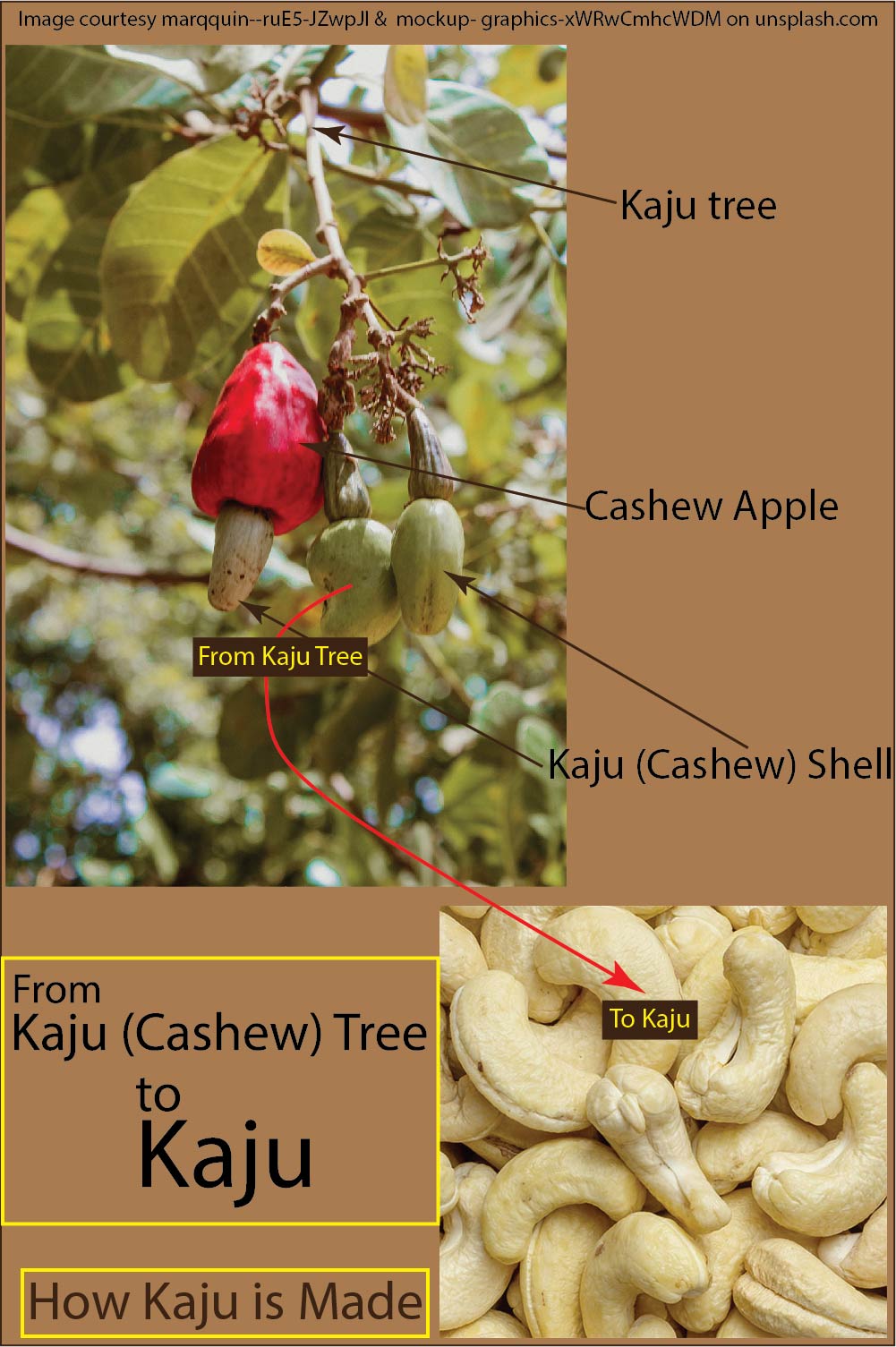
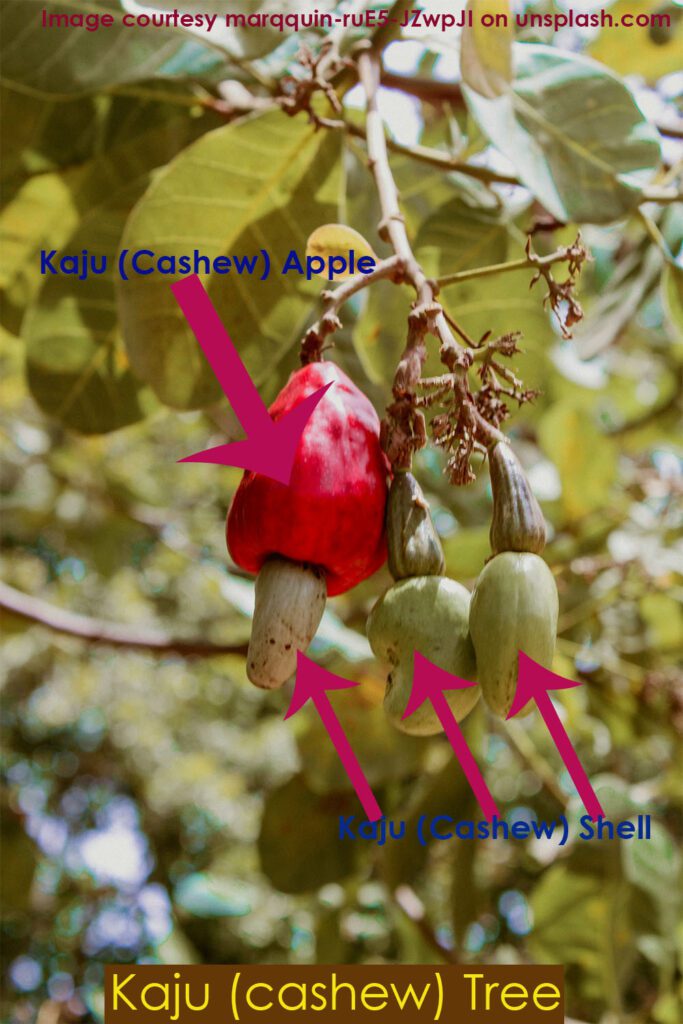
Cashew grows on trees in the form of a fruit. The fruit resembles a bell pepper and is called a cashew apple. The kidney-shaped cashew shell grows attached to the bottom of the cashew apple. Actually, the cashew shell grows first and then its fruit.
Brazil is the native country of the Cashew. Cashew trees grow in tropical countries such as India, Sri Lanka, Vietnam, Tanzania, Ghana, the Ivory Coast, the Philippines, etc. Maharashtra, Andhra Pradesh, Odisha, Karnataka, Tamil Nadu, Kerala, Chhattisgarh, West Bengal, Meghalaya, Gujarat, and Goa are the major Kaju growing states in India.
Cashew has different names in Indian languages. It is called Kaju in Hindi, Marathi, Gujarati, and Konkani. It is called Godambi in Kannada, Mundiri in Tamil, Kasu in Malayalam, Jeeedi Pappu in Telugu, and Hijli Badam in Bengali. I will use the terms Kaju and Cashew in this article, since the majority understands them.
The Kaju kernel is enclosed in a hard shell. It is a two-layer shell. One thick outer shell and a thin inner shell. The Kaju with a shell is also called a pod or drupe.
Even though Kaju is grown on trees, you cannot eat it raw. Raw Kaju shells have toxic oil and acids harmful to human skin and need processing to make them edible. This article explains how Kaju is made from fresh-harvested Kaju shells.
Presently, Vietnam is the largest exporter of processed Kaju. Vietnam overtook India’s position as the largest Kaju exporter by heavily investing in the mechanization of Kaju processing.
Processing of Kaju
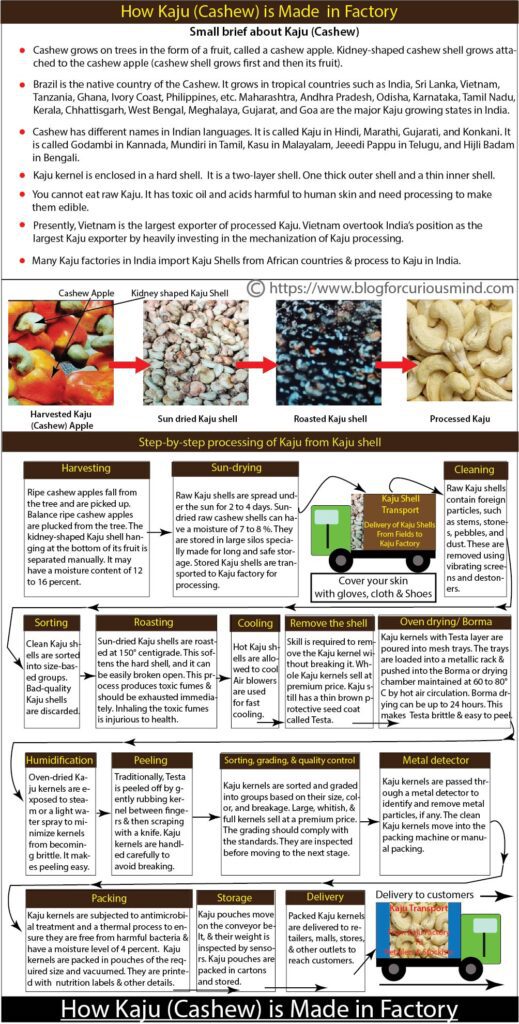
Kaju processing is traditionally done manually (using hands) to ensure the highest yield of whole Kajus. However, many Kaju processing factories have mechanized their process. The following steps are involved in Kaju processing.
Step 1-Harvesting
Cashew shell, along with cashew apple, grows on trees. Ripe cashew apples fall from the tree and are picked up. Balance ripe cashew apples are plucked from the tree. The kidney-shaped Kaju shell hanging at the bottom of its fruit is separated manually.
The Kaju shells are moved for sun-drying. Cashew apples may be sent to the factory to make an alcoholic drink. Freshly harvested Kaju shells may have a moisture content of 12 to 16 percent.
Plucking cashew apples from the tree and separating cashew shells from the fruit should be done with care and while wearing hand gloves. The Kaju shell contains oils and acids that can cause skin irritation and burn.
Step 2- Sun-drying raw Kaju (cashew) shells
Freshly harvested raw Kaju shells are spread under the sun on a hard, clean surface. The sun-drying will last 2 to 4 days. The sun-dried raw cashew shells can have a moisture of 7 to 8 percent.
The sun-dried Kaju shells are stored in large silos specially made for long and safe storage. The low moisture minimizes the chances of mold (fungus) growth. The stored Kaju shells are processed into edible Kaju until the next harvest. The storage is under controlled moisture.
Step 3- Cleaning
The raw Kaju shells contain foreign particles, such as stems, stones, pebbles, and dust. Foreign particles are removed using vibrating screens and destoners.
Step 4- Sorting
The clean Kaju shells are sorted into size-based groups. Bad-quality Kaju shells are discarded.
Step 5- Roasting
The sun-dried Kaju shells are roasted at 150° centigrade for about 2 minutes. Alternately, they can be steamed for up to 20 minutes. Roasting or steaming softens the hard shell, and it can be easily broken open. This process produces toxic fumes and should be exhausted immediately. Inhaling the toxic fumes is injurious to health.
Step 6- Cooling
The hot Kaju shells are allowed to cool. Fast cooling is possible by exposing hot Kaju shells to air blowers.
Step 7- Remove the shell (shelling)
Removing the kidney-shaped Kaju kernel from its shell is a slow, laborious, and skilled job. Skill is required to remove the Kaju kernel without breaking it. A whole Kaju kernel is worth much more than a broken Kaju. Kaju still has a thin brown protective layer called the Testa or seed coat over it.
Oils and acids in the Kaju shell are harmful to human skin. Wearing hand gloves is important for safety.
Step 8- Hot air oven drying (Borma)
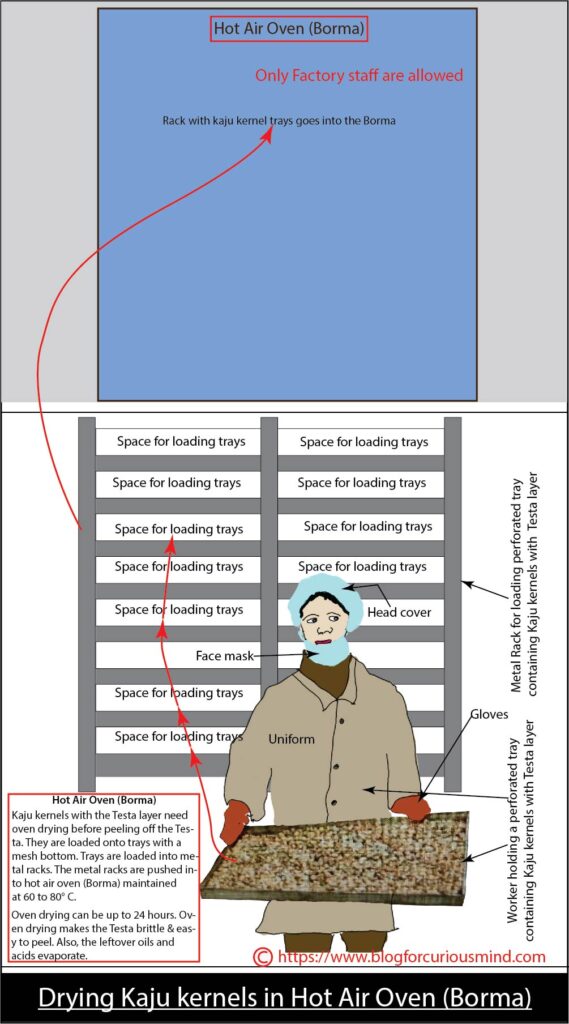
The Kaju kernels with the Testa layer need oven drying before peeling off the Testa. They are loaded onto trays with a mesh bottom. These trays are loaded into a metallic rack.
Racks containing Kaju kernels are pushed into a hot air oven (called Borma) maintained at 60 to 80° Celsius. The oven drying can be up to 24 hours. Oven drying makes the Testa brittle and easy to peel. Also, the leftover oils and acids evaporate.
Step 9- Humidification
The oven-dried Kaju kernels are exposed to steam or a very light water spray. This minimizes the kernels from becoming brittle. It also makes peeling easy.
Step 10- Peeling
Traditionally, the Testa is peeled off by gently rubbing the kernel between fingers and then scraping with a knife. Kaju kernels are handled carefully to avoid breaking. This process is safe since all the oils and chemicals in the Kaju kernel are dried out.
Step 11- Sorting, grading, and quality control
The Kaju kernels are sorted and graded into groups based on their size, color, and breakage. Large, whitish, and full kernels sell at a premium price. The grading should comply with the standards stipulated by the concerned State Authorities. The graded Kaju kernels are inspected before moving to the next stage.
Step 12- Metal detector
The Kaju kernels are passed through a metal detector to identify and remove metal particles, if any. The clean Kaju kernels move into the packing machine or manual packing.
Step 13- Packing
The Kaju kernels are subjected to antimicrobial treatment and a thermal process to ensure they are free from harmful bacteria and have a moisture level of 4 percent. The Kaju kernels are packed in pouches of the required size and vacuumed.
The pouches are printed with labels with nutrition and other details.
Step 14- Storage
The Kaju pouches move on the conveyor belt, and their weight is inspected by sensors. The Kaju pouches are packed in cartons and stored.
Step 15- Delivery
Packed Kaju kernels are delivered to retailers, malls, stores, and other outlets to reach customers.
Note: Many Kaju factories in India import sun-dried Kaju shells from African countries and process them in India. Processed Kaju is sold in India and exported to many countries.
You may watch these three YouTube videos on how Kaju is made. Video 1, Video 2, and Video 3.
Mechanization
Traditionally, the processing of Kaju from Kaju shells is done manually. However, high-tech automatic machines are available for removing the Kaju kernels from their shells, the Testa layer from the Kaju kernels, packing, and other jobs.
However, since the shape and size of the Kaju shells vary, the machines are not capable of ensuring zero breakage of kernels. Also, machines are expensive, and keeping them idle due to the nonavailability of Kaju shells is costly. Due to this reason, the majority of the Kaju processing factories follow manual processing with limited use of machinery (like packing machines).
An ideal mechanized Kaju processing factory employing 30 persons can output 50,000 kgs of Kaju kernels per day.
You may watch YouTube Video 1 and Video 2 on this.
Pros and cons of mechanized Kaju processing
Pros of using automatic machines for Kaju processing
- Faster production and a greater quantity of Kaju shells can be processed each day.
- Low labor cost results in a low price for processed Kaju. This makes the product competitive in the market.
- Kaju shells do not come in contact with human skin. Human health safety is ensured.
Cons of using automatic machines for Kaju processing
- Huge initial investment in machinery. The investment can be justified only by running it throughout the year.
- Unlike manual processing, the mechanized processing of Kaju shells cannot assure a hundred percent whole Kaju kernels. There will be many broken Kajus.
- The color of the machine-processed Kaju will not be as bright as that of manually processed Kajus.
Pros and cons of manual Kaju processing
Pros of manually processed Kajus
- Manual processing ensures a near 100 percent whole Kaju kernels.
- Manually processed Kaju kernels look bright and attractive.
- Employs the local people. This is an important consideration in countries like India, Sri Lanka, and African countries.
Cons of manually processed Kajus
- Kaju shells contain toxic oil and acids, and they can seriously affect human skin if care is not taken.
- High labor costs and low productivity increase the cost of processed Kaju kernels.
Health benefits of Kaju
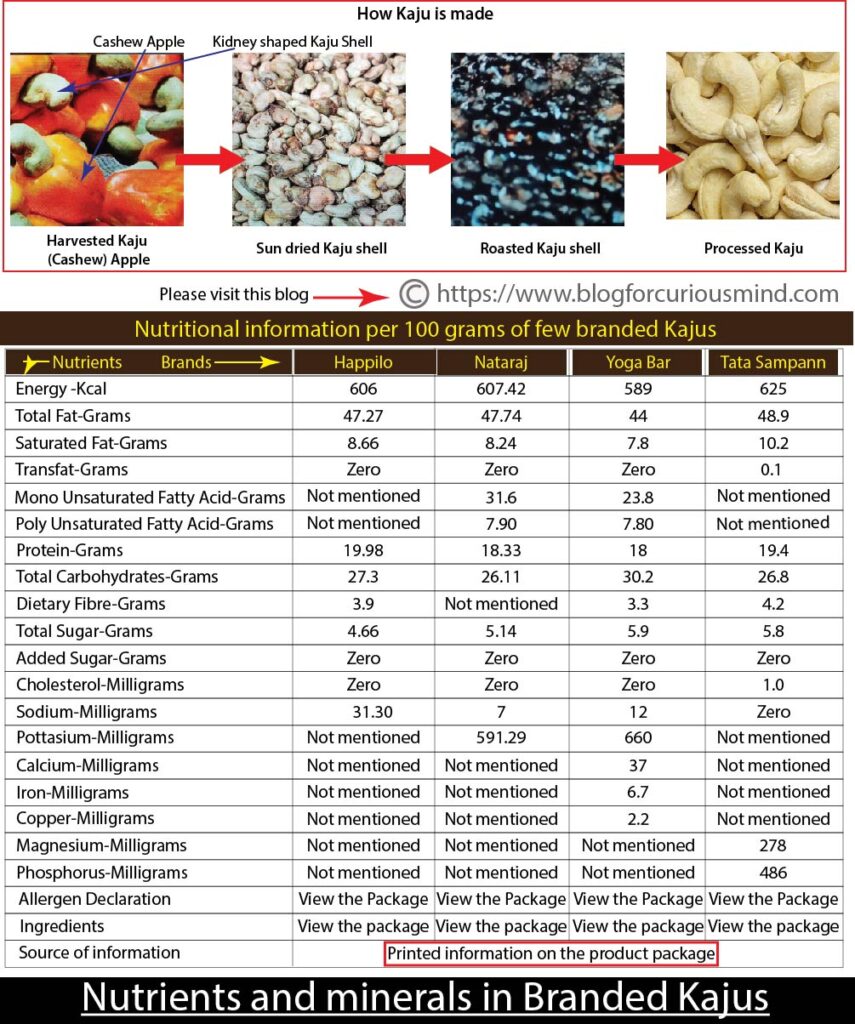
Kaju has low sugar content and contains antioxidants and fiber. Additionally, it is rich in protein, vitamins, and minerals. Nutrients in four branded Kajus are compiled in the image below.
Cashew milk and cream are excellent substitutes for dairy for vegans. Cashew milk and cream are major ingredients in vegan desserts.
Why is Kaju so costly?
Kaju (Cashew) is grown in trees as a Cashew apple. Each Cashew apple has only one shell containing Kaju. The Kaju shell contains toxic oils and acids harmful to human skin and becomes edible only after laborious processing. All these make the Kaju costly. Whole Kaju kernels are sold at a premium, while broken Kaju is comparatively cheaper.
Conclusion
Kaju is a tasty snack. Many Indian curries, sweets, and Kheers are incomplete without Kaju. Many of us may have thought that Kaju can be plucked from a tree and eaten raw. This article has explained the sweat of the people who process and bring Kaju to the dining tables. Next time, when you relish a snack of Kaju or a bite of Kaju Barfi, thank the people who sweat to process Kaju shells into edible Kaju.
You may read the following articles:
How Poha is made from rice (paddy)
What is Sabudana and how it is made in India
Roasted Chana manufacturing process
How Ragi Huri Hittu or popped ragi powder is made
References
https://en.wikipedia.org/wiki/Cashew
https://cashewcoast.com/en/resources/the-5-steps-of-processing-raw-cashew-nuts
https://www.foodunfolded.com/article/cashew-nuts-how-its-made
https://foragerproject.com/blogs/blog/all-about-cashews-cracking-the-nut